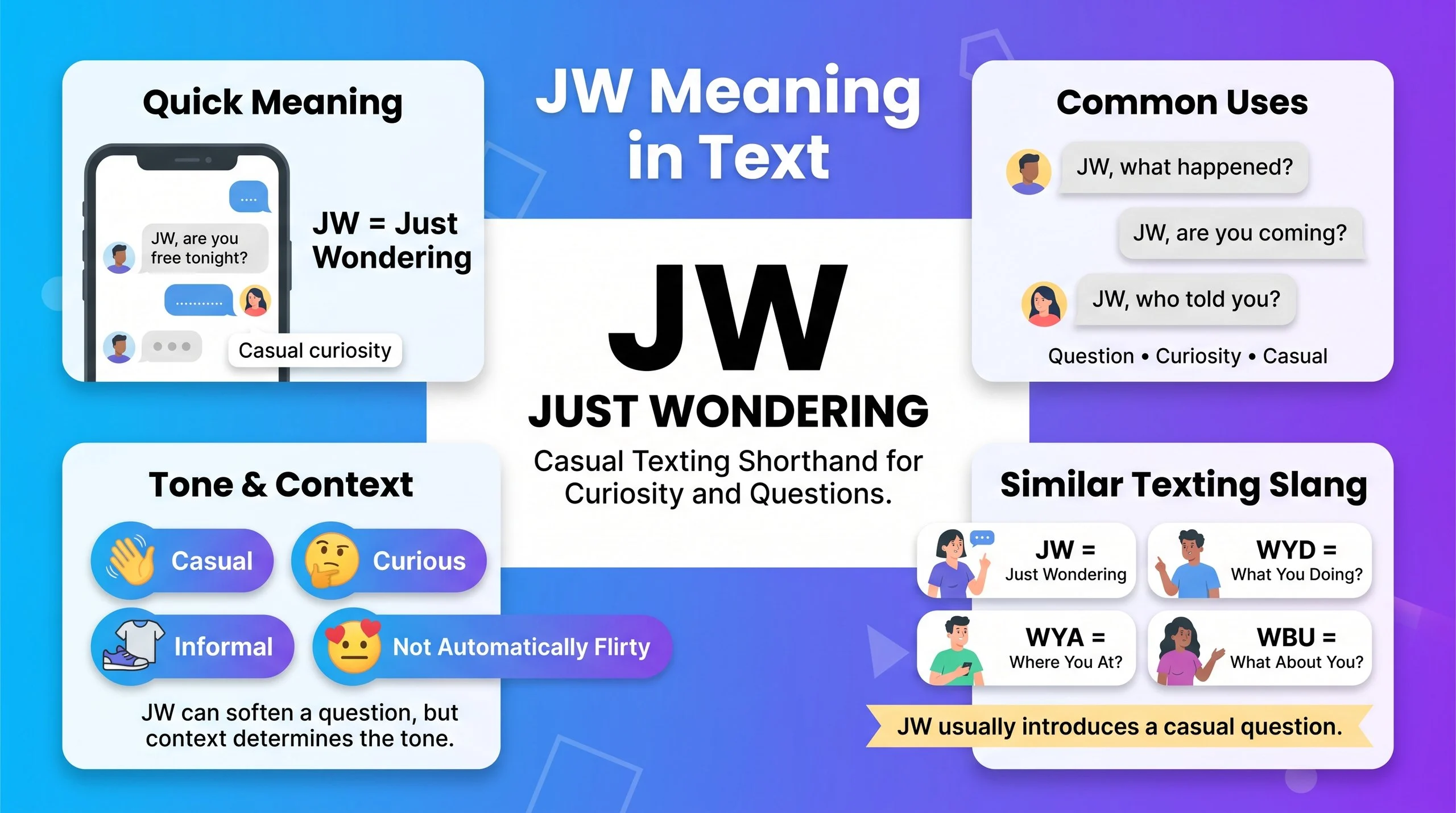
JW usually means “Just Wondering” in text messages and online chats. People use JW when they want to ask a casual question without making it sound too serious. For example, “JW, are you coming?”
JW meaning in text is usually “Just Wondering.” People use this casual abbreviation when they want to ask something without sounding demanding, serious, or overly direct. It often appears before or after a question.
For example, someone might text, “JW, what are you doing later?” This simply means, “Just wondering, what are you doing later?”
JW can make a question sound more relaxed. However, the tone still depends on the conversation, punctuation, and relationship between the people texting. In some contexts, JW can have other meanings, so the surrounding message matters.
Whether you see JW on Snapchat, TikTok, Instagram, or a regular text message, “Just Wondering” is the most common casual texting interpretation.
What Does JW Mean in Text?
| Term | Meaning | Common Use |
|---|---|---|
| JW | Just Wondering | Asking a casual question |
| JW? | Just wondering? | Informal question |
| JW, are you free? | Just wondering, are you free? | Casual check-in |
| JW what happened | Just wondering what happened | Asking for information |
JW is generally used to make a question sound more casual or less demanding.
What Does JW Mean in Text?
In texting, JW usually means “Just Wondering.”
It is often placed at the beginning of a question.
For example:
“JW, are you going tonight?”
This means:
“Just wondering, are you going tonight?”
The phrase can soften the question. Instead of directly asking someone what they are doing, the sender adds JW to show casual curiosity.
Similarly:
“JW, why did you leave early?”
means:
“Just wondering, why did you leave early?”
The abbreviation is short, simple, and common in informal digital conversations.
What Does “Just Wondering” Mean?
“Just wondering” means that someone is curious about something but does not necessarily expect a serious explanation.
For example:
“JW, what time are you getting here?”
The sender simply wants information.
Likewise:
“JW, did you talk to Sarah?”
This can sound more relaxed than:
“Did you talk to Sarah?”
However, context still matters. If someone asks a sensitive question and adds JW, the phrase may not completely remove the seriousness of the question.
Why Do People Use JW in Texting?
People use JW for several reasons.
To Sound Casual
JW can make a question feel less formal.
“JW, what are you doing tonight?”
It sounds like casual curiosity.
To Soften a Question
Some questions can sound direct. Adding JW can make them feel less demanding.
“JW, are you still upset?”
This may feel softer than asking the same question without JW.
To Show Curiosity
JW can simply signal that someone wants information.
“JW, where did you get that shirt?”
The sender is showing interest without making the question sound overly serious.
To Avoid Sounding Demanding
JW can communicate that the sender is asking out of curiosity rather than making a demand.
Therefore, it is especially common in casual conversations.
JW Examples in Text Messages
Here are some natural examples of JW in everyday texting.
Example 1:
“JW, are you free tonight?”
Meaning: “Just wondering, are you free tonight?”
Example 2:
“JW, did you finish the assignment?”
Meaning: “Just wondering, did you finish the assignment?”
Example 3:
“JW what happened yesterday?”
Meaning: “Just wondering what happened yesterday.”
Example 4:
“You still coming? JW.”
This use is less common, but the sender may be emphasizing casual curiosity.
Example 5:
“JW, who told you?”
Meaning: “Just wondering, who told you?”
JW Meaning on Snapchat
On Snapchat, JW usually means “Just Wondering.”
It can appear in direct messages or casual conversations.
For example:
“JW, where are you?”
The sender is casually asking where you are.
Similarly:
“JW, are you going to the party?”
means:
“Just wondering, are you going to the party?”
Because Snapchat conversations are usually informal, shortened expressions such as JW fit naturally into messages.
JW Meaning on TikTok
On TikTok, JW may appear in comments or direct messages.
For example:
“JW, what song is this?”
The person is simply asking which song appears in the video.
Another example is:
“JW, why does everyone know this trend?”
Here, JW introduces a casual question.
However, social media context can influence how the message sounds. A comment may feel more playful, while a private message may feel more personal.
JW Meaning on Instagram
On Instagram, JW can appear in DMs, comments, or replies.
For example:
“JW, where did you buy that?”
This means:
“Just wondering, where did you buy that?”
A person might also use it when asking about plans:
“JW, are you going out tonight?”
Therefore, JW works much like it does in ordinary texting.
JW Meaning From a Girl
If a girl sends JW, it usually means “Just Wondering.”
For example:
“JW, are you talking to anyone?”
The person is asking a question and presenting it as casual curiosity.
However, JW alone does not prove romantic interest.
The rest of the conversation provides more information. If the message includes personal questions, teasing, compliments, or other romantic signals, the overall conversation may have a different tone.
Still, the abbreviation itself simply means “Just Wondering.”
JW Meaning From a Guy
If a guy sends JW, it generally has the same meaning: “Just Wondering.”
For example:
“JW, are you going to the game?”
This is simply a casual question.
Likewise:
“JW, who were you with?”
could indicate curiosity about someone’s plans or activities.
However, the abbreviation itself does not automatically make the message flirty or romantic.
Is JW Flirty?
JW is not inherently flirty.
The phrase “Just Wondering” is neutral. People use it for everyday questions, personal questions, and casual curiosity.
For example:
“JW, what time does the movie start?”
is clearly not flirty.
On the other hand:
“JW, are you seeing anyone?”
could potentially appear in a flirtatious conversation.
Therefore, the question itself and the surrounding conversation matter more than JW.
Is JW Rude?
JW is usually not rude.
In fact, it can make a question sound less demanding.
Compare:
“Why did you leave?”
with:
“JW, why did you leave?”
The second version can sound more casual or softer.
However, tone depends on context. A person can still ask a rude or intrusive question while using JW.
For example:
“JW, how much money do you make?”
Adding JW does not automatically make a sensitive question appropriate.
Common JW Phrases
“JW”
Usually means “Just Wondering.”
“JW.”
“JW, are you free?”
Means:
“Just wondering, are you free?”
“JW, what happened?”
Means:
“Just wondering, what happened?”
“JW, where are you?”
Means:
“Just wondering, where are you?”
“JW, why?”
Means:
“Just wondering, why?”
These phrases are generally casual and conversational.
JW vs. Similar Texting Abbreviations
| Abbreviation | Meaning | Main Purpose |
|---|---|---|
| JW | Just Wondering | Casual curiosity |
| WYM | What You Mean | Asking for clarification |
| WDYM | What Do You Mean? | Asking for clarification |
| WYA | Where You At? | Asking someone’s location |
| WYD | What You Doing? | Asking what someone is doing |
| WBU | What About You? | Returning a question |
| IDK | I Don’t Know | Showing uncertainty |
| TBH | To Be Honest | Introducing an honest opinion |
JW is different because it usually introduces a question rather than answering one.
Common Mistakes When Using JW
Mistake 1: Thinking JW Always Means One Thing
JW commonly means “Just Wondering,” but abbreviations can have different meanings in specialized settings.
Therefore, consider the context.
Mistake 2: Assuming JW Is Flirty
JW does not automatically indicate romantic interest.
For example:
“JW, what time is the meeting?”
is clearly ordinary curiosity.
Mistake 3: Thinking JW Makes Every Question Casual
Adding JW can soften a question, but it does not remove the meaning or sensitivity of the question.
Mistake 4: Using JW in Formal Writing
JW is best for informal messages.
In professional or academic communication, write “I was wondering” instead.
Mistake 5: Confusing JW With Other Abbreviations
JW is not the same as WYA, WYD, WBU, or WDYM.
Each abbreviation serves a different purpose.
How to Respond to JW
The best response depends on the question that follows JW.
If Someone Asks About Your Plans
“JW, are you free tonight?”
You could reply:
“Yeah, I’m free.”
If Someone Asks for Your Opinion
“JW, do you like this?”
You could say:
“Yeah, I actually like it.”
If Someone Asks a Personal Question
“JW, are you seeing anyone?”
You can answer honestly or keep your response private.
“Not really. Why?”
If You Do Not Understand
You can ask:
“What are you wondering about?”
This keeps the conversation natural.
When Should You Use JW?
Use JW when you want to introduce a casual question.
It works well in:
- Text messages
- Snapchat chats
- Instagram DMs
- TikTok messages
- Group chats
- Conversations with friends
- Casual online communities
For example:
“JW, are you still coming?”
However, avoid JW in formal emails, academic writing, official documents, or professional messages.
Instead, write:
“I was wondering if you are still coming.”
Other Meanings of JW
Although “Just Wondering” is a common texting interpretation, JW can have other meanings outside casual chat.
Depending on the context, JW may refer to:
- Jehovah’s Witnesses in religious discussions
- Just Wondering in casual texting
- Initials or a person’s name
- Organization-specific terminology
- Professional or technical abbreviations
Therefore, the surrounding words and conversation determine the intended meaning.
Frequently Asked Questions
1. What does JW mean in text?
JW usually means “Just Wondering.” People use it before a casual question to show curiosity without making the question sound overly serious or demanding.
2. What does JW stand for in texting?
In casual texting, JW commonly stands for “Just Wondering.” For example, “JW, are you free?” means “Just wondering, are you free?”
3. What does JW mean on Snapchat?
On Snapchat, JW usually means “Just Wondering.” Someone might write “JW, where are you?” to casually ask about your location or plans.
4. Is JW flirty in texting?
JW is not inherently flirty. It simply means “Just Wondering.” However, the question that follows it can sometimes be personal or romantic, depending on the conversation.
5. Is JW rude?
JW is generally not rude. It can make a question sound more casual. Still, the question itself may be sensitive or intrusive, so context matters.
6. What does JW mean from a girl?
When a girl sends JW, it usually means “Just Wondering.” The abbreviation alone does not indicate flirting. Look at the question and the rest of the conversation for tone.
7. What does JW mean from a guy?
When a guy sends JW, it usually means “Just Wondering.” For example, “JW, are you coming?” is simply a casual question about someone’s plans.
8. How should I respond to JW?
Read the question after JW and answer it naturally. If the question is unclear, you can ask, “What are you wondering about?” If it is personal, you can choose how much information to share.
Conclusion
JW usually means “Just Wondering” in text. It is a casual abbreviation that people use when asking a question or showing curiosity. For example, “JW, are you free?” means “Just wondering, are you free?” The phrase can make a question sound more relaxed and less demanding. However, JW is not automatically flirty or romantic. The question that follows it provides more information about the sender’s intention. JW works well in texts, social media messages, and group chats. For formal communication, writing “I was wondering” is clearer. Ultimately, the surrounding conversation determines how JW should be understood.

Andrew Morris is a writer at Meaninga.com who specializes in word meanings, slang, idioms and modern language trends. He creates clear, accurate and easy to understand content for everyday readers.