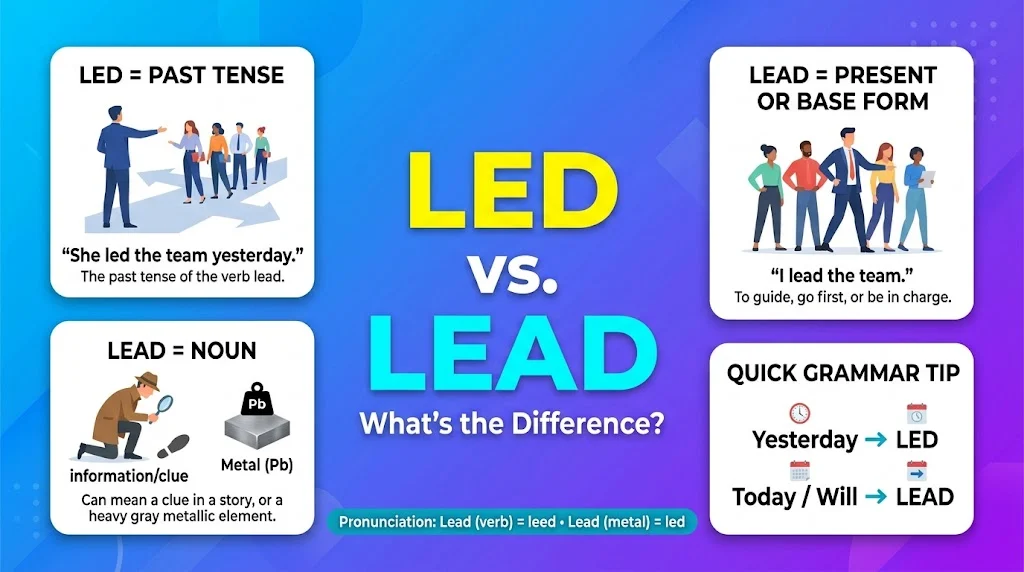
Led is the past tense of lead, meaning to guide, direct, or show the way. Lead is usually a present-tense verb pronounced “leed.” As a noun, lead can also mean a clue or a type of metal, pronounced “led.”
Led or lead is a common English grammar question because these words look almost identical but have different meanings and pronunciations. The main difference is time: lead is the present-tense verb, while led is its past tense. For example, you might say, “I lead the team today,” but “I led the team yesterday.” However, lead has other meanings, too. It can refer to a clue in an investigation or a soft, heavy metal. These meanings can make the spelling confusing, especially because the metal lead is pronounced like led. This guide explains when to use each word, provides simple examples, and covers common mistakes so you can choose the correct spelling with confidence.
What Is the Difference Between Led and Lead?
The main difference between led and lead is their grammatical use.
- Led: The past tense and past participle of the verb lead. It describes guiding or directing someone in the past.
- Lead: The present-tense form of the verb lead. It means to guide, direct, or take charge. It can also be a noun with other meanings.
For example:
- Present: “I lead the project.”
- Past: “I led the project last year.”
- Future: “I will lead the project next month.”
The easiest rule to remember is that led refers to the past when used as the verb, while lead is used for the present and base form.
When Should You Use Led?
Use led when describing an action that has already happened. It is the correct past tense of lead.
Examples:
- She led the group through the museum.
- Our coach led the team to victory.
- The manager led an important meeting yesterday.
- His research led to a new discovery.
- They led the campaign for several months.
In each sentence, the action occurred in the past.
Led in Everyday Sentences
Here are a few examples from common situations:
- At work: “Maria led the training session on Monday.”
- In sports: “The captain led the team during the final match.”
- In school: “Our teacher led a discussion about history.”
- In a story: “The path led us to an old cabin.”
Notice that led can describe guiding people or causing a particular result.
When Should You Use Lead?
Use lead as the base form of the verb meaning to guide, direct, or take charge. It can appear in the present tense and after words such as will, can, should, and to.
Examples:
- I lead a small marketing team.
- She will lead the presentation tomorrow.
- We need someone to lead the discussion.
- Good communication can lead to better results.
- He wants to lead the organization.
Lead as a Noun
The word lead also has several noun meanings.
1. A clue or piece of information
- The detective found a new lead in the case.
- This phone number might be a useful lead.
In these examples, lead is pronounced “leed.”
2. A position ahead of others
- Our team has a two-point lead.
- The runner maintained her lead throughout the race.
This meaning is also pronounced “leed.”
3. A type of metal
- Older pipes sometimes contained lead.
- The paint was tested for lead.
In this context, lead is pronounced “led,” like the past-tense verb led.
Led vs. Lead: Quick Comparison
| Word | Meaning | Pronunciation | Example |
|---|---|---|---|
| Led | Past tense of lead | “Led” | She led the team. |
| Lead (verb) | Guide or direct | “Leed” | I lead the team. |
| Lead (noun) | A clue or advantage | “Leed” | We found a new lead. |
| Lead (metal) | A heavy chemical element | “Led” | Lead can be toxic. |
How to Remember Led or Lead
Try these simple tips to choose the correct word.
1. Check the Time
If the action happened in the past, use led.
- Correct: “He led the project last year.”
- Incorrect: “He lead the project last year.”
If the action is happening now or refers to the base form, use lead.
- Correct: “He leads the project now.”
- Correct: “He will lead the project.”
2. Use “Will” as a Clue
When you are talking about the future, the correct verb form is lead, not led.
- Correct: “She will lead the team.”
- Incorrect: “She will led the team.”
3. Remember the Metal Exception
The noun lead, meaning the metal, is pronounced “led.” However, its spelling remains lead.
For example: “The old paint may contain lead.”
The pronunciation alone does not determine the spelling. Meaning and grammar matter, too.
Common Mistakes With Led and Lead
Mistake 1: Using Lead for a Past Action
Incorrect: “They lead the group yesterday.”
Correct: “They led the group yesterday.”
Because yesterday refers to the past, use led.
Mistake 2: Using Led After Will
Incorrect: “I will led the meeting.”
Correct: “I will lead the meeting.”
After will, use the base form of the verb.
Mistake 3: Confusing the Verb With the Metal
Incorrect: “The pipes were made from led.”
Correct: “The pipes were made from lead.”
When referring to the metal, spell the word lead, even though it sounds like led.
Mistake 4: Assuming Lead Is Always Pronounced the Same Way
The verb lead is pronounced “leed,” while the metal lead is pronounced “led.” Pay attention to the context to understand which meaning applies.
Led or Lead: Practice Quiz
Choose the correct word in each sentence.
- The teacher ___ the class yesterday.
- I will ___ the meeting tomorrow.
- The detective discovered a new ___.
- She has ___ the team through several difficult projects.
- The building was tested for ___.
Answers:
- Led
- Lead
- Lead
- Led
- Lead
In sentence four, has led uses the past participle of the verb. In sentence five, lead refers to the metal.
Frequently Asked Questions
1. Is it led or lead a team?
Both can be correct. Use lead a team for the present or base form, as in “I lead a team.” Use led a team for the past, as in “I led a team last year.”
2. Is led the past tense of lead?
Yes. Led is the simple past tense and past participle of the verb lead. For example, “She led the group” and “She has led the group.”
3. Is it I led or I lead?
It depends on the time. Use “I lead” for the present or a regular responsibility. Use “I led” for an action completed in the past.
4. Is it lead by example or led by example?
Both forms are possible in different sentences. Use “lead by example” for a general instruction or present-tense action. Use “led by example” when describing someone who did so in the past.
5. Why is lead sometimes pronounced led?
The noun lead, referring to the metal, has a different pronunciation from the verb lead. The metal is pronounced “led,” while the verb meaning “guide” is pronounced “leed.”
6. Is it has led or has lead?
The correct form is has led when using the verb meaning “guide” or “direct.” For example, “She has led the department for five years.”
7. Is it lead to or led to?
Use lead to for the base or present form, as in “These changes can lead to success.” Use led to for a past result, as in “The changes led to success.”
8. What is an easy trick to remember led vs. lead?
Remember that led is the past tense of the verb lead. If you can add yesterday naturally, led may be correct. If you use will before the verb, use lead: “will lead,” never “will led.”
Conclusion
Choosing between led or lead becomes easier when you identify the meaning and tense. Use led when describing a past action, such as “She led the team.” Use lead for the present or base form, as in “She will lead the team.” Remember that lead can also mean a clue, an advantage, or a type of metal. Its pronunciation changes depending on the meaning. When in doubt, check the sentence’s time frame and grammatical structure. With a little practice, you can use both words accurately in everyday writing.

Andrew Morris is a writer at Meaninga.com who specializes in word meanings, slang, idioms and modern language trends. He creates clear, accurate and easy to understand content for everyday readers.