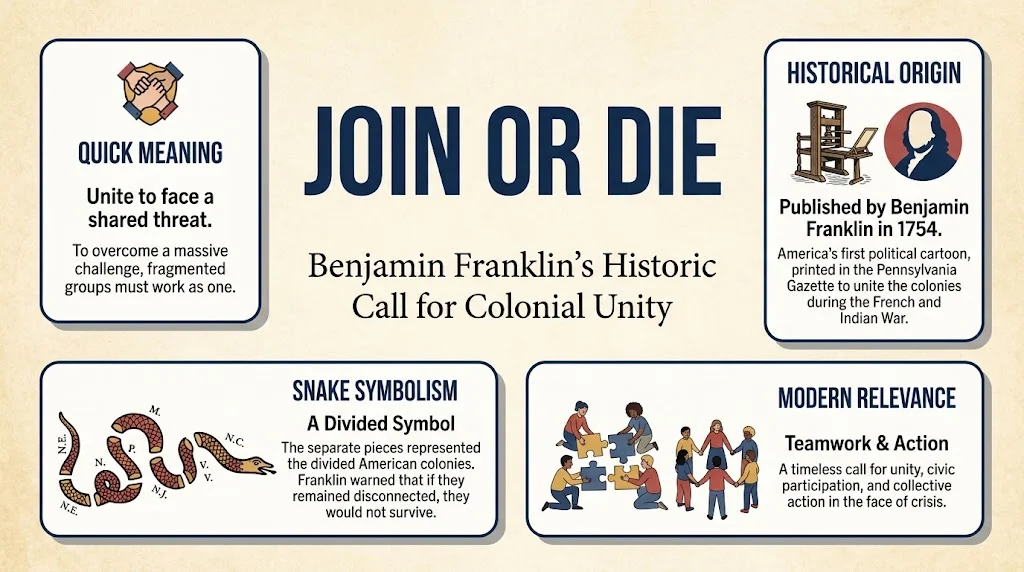
Join or Die is a famous political phrase associated with Benjamin Franklin’s 1754 cartoon. It urged the American colonies to unite for their shared defense. Today, the phrase symbolizes unity, collective action, and the consequences of division.
Join or Die is a historic phrase that represents the importance of unity when facing a common threat. Benjamin Franklin popularized it in 1754 through a political cartoon showing a snake divided into separate sections, each labeled with the initials of an American colony or region. The image encouraged the colonies to cooperate during a period of growing conflict in North America. Later, the phrase became closely associated with the American Revolution and the movement toward independence. However, its meaning extends beyond history. Today, people use “Join or Die” to discuss teamwork, political movements, social causes, and the need for cooperation. Understanding its historical background reveals why this short phrase became one of the most recognizable symbols of American unity.
What Does Join or Die Mean?
Join or Die means that people must unite and cooperate to survive, succeed, or resist a shared threat. The phrase presents unity as essential and division as dangerous.
Its meaning depends on the situation. In a historical discussion, it refers to the need for the American colonies to work together. In modern conversations, it can describe a group that needs stronger teamwork or a movement that encourages people to participate.
For example:
- A history teacher may use “Join or Die” to explain colonial cooperation.
- A community organizer might use the phrase to encourage people to support a shared cause.
- A sports team could use it as a dramatic slogan about working together.
The wording is forceful because it presents two opposing choices: unite or face the consequences of remaining divided.
The History of Join or Die
Benjamin Franklin’s Cartoon in 1754
Benjamin Franklin published the original Join, or Die political cartoon in 1754. It appeared in the Pennsylvania Gazette during a period of tension between British and French interests in North America.
The cartoon showed a snake cut into separate pieces. Each section represented a colony or region. The divided snake served as a visual warning that the colonies would be weaker if they failed to cooperate.
Franklin used the image to support greater colonial coordination, particularly in matters of defense. The cartoon appeared as British colonies faced growing pressure during the conflict that developed into the French and Indian War.
The Albany Congress
The cartoon was connected to discussions about colonial cooperation surrounding the Albany Congress of 1754. Delegates from several British colonies met in Albany, New York, to discuss relations with Indigenous nations and ways to improve colonial defense.
Franklin supported a proposal known as the Albany Plan of Union. It called for a more coordinated colonial government, although the plan was not adopted by the colonies or the British government.
The cartoon reflected Franklin’s belief that separate colonies could accomplish more by working together.
Connection to the American Revolution
More than two decades later, the phrase gained renewed significance as resistance to British rule grew. During the American Revolution, supporters of independence used the divided-snake image to encourage unity among the colonies.
The original cartoon was created before the revolutionary movement fully developed, but its message became useful in a different political context. Colonists who disagreed on many issues still faced the challenge of coordinating their opposition to British policies.
As a result, Join or Die became associated with the broader idea that cooperation was necessary for collective political action.
What Does the Join or Die Snake Represent?
The snake is the most recognizable feature of the original cartoon. Its divided body communicates the central message without requiring a long explanation.
A Divided Snake
The snake appears in separate segments rather than as one complete animal. This division symbolizes colonies acting independently instead of as a united group.
The Colony Labels
The segments carry initials representing colonial regions. These labels connected the illustration directly to the political geography of British North America in the eighteenth century.
The Warning of Weakness
The image suggests that separate pieces cannot function as effectively as a complete snake. In the cartoon’s political message, divided colonies risked being less capable of defending themselves.
The Call for Cooperation
The phrase beneath the image turns the illustration into a direct appeal. It asks the colonies to recognize their shared interests and coordinate their actions.
Why Was a Snake Used in the Cartoon?
The snake made the message memorable. Rather than presenting a complicated political argument in a lengthy article, Franklin used a simple illustration that readers could quickly understand.
Snakes also carried symbolic meaning in European and colonial visual culture. Their appearance in political imagery could communicate danger, resistance, or collective strength, depending on the context.
In Franklin’s cartoon, the divided body was the key detail. The snake’s recognizable shape helped readers understand what was missing: a complete, united whole.
The cartoon therefore worked as both political commentary and a visual argument for cooperation.
How Is Join or Die Used Today?
Although the phrase originated in colonial politics, people still use it in different settings.
Politics and Civic Engagement
Political commentators may use “Join or Die” to argue that people with shared interests should organize instead of acting separately. Its historical associations make it particularly relevant to discussions about American politics and civic participation.
Teamwork and Leadership
A manager, coach, or team leader might use the phrase to emphasize that individual effort is not enough when a group faces a difficult challenge.
In this context, the expression is usually metaphorical. It means that the group needs cooperation to succeed.
Social Movements
Activists may use the slogan to encourage participation in a campaign or cause. It communicates urgency and suggests that collective action can be more effective than isolated efforts.
Games and Entertainment
The phrase also appears in popular culture, including titles, slogans, merchandise, and entertainment. Its dramatic wording makes it suitable for stories about survival, competition, conflict, and group loyalty.
However, the meaning may change depending on the work in which it appears. A modern use does not necessarily refer directly to Benjamin Franklin’s original political argument.
Is Join or Die a Threat?
The phrase sounds threatening because it presents a stark choice. Historically, however, its main purpose was to persuade the colonies to unite for their shared defense.
In modern usage, it can be a dramatic way to describe the importance of cooperation. It does not automatically mean that someone is making a literal threat.
Context matters. A history textbook may discuss the phrase as a colonial slogan, while a fictional story might use it to create suspense or suggest that a group must cooperate to survive.
Join or Die vs. United We Stand
Both expressions emphasize unity, but they communicate the idea differently.
| Phrase | Main Meaning | Tone |
|---|---|---|
| Join or Die | Unite or risk serious consequences | Urgent and forceful |
| United We Stand | People are stronger when they support one another | Encouraging and resolute |
| Strength in Numbers | A group can be more powerful than individuals acting alone | Practical |
| Divide and Conquer | Separation can make a group easier to control | Strategic warning |
“Join or Die” focuses on the danger of remaining divided. In contrast, “United We Stand” emphasizes the strength that comes from cooperation.
Common Misunderstandings About Join or Die
It Was Not Originally a Revolutionary War Cartoon
Franklin created the cartoon in 1754, before the American Revolution began in 1775. Its later use during the revolutionary period helped strengthen its association with American independence.
It Did Not Show the United States as a Fully Formed Country
At the time of publication, the colonies were still under British rule. The cartoon called for cooperation among colonial regions rather than unity within an already independent United States.
The Snake Was Divided on Purpose
The separated segments were central to the cartoon’s argument. They represented political division and the need for a more coordinated response.
The Phrase Does Not Always Have a Literal Meaning
Today, the expression is often used metaphorically. It can describe teamwork, collective action, or the urgency of joining a group effort.
Frequently Asked Questions
1. Who created Join or Die?
Benjamin Franklin created the Join, or Die political cartoon in 1754. It appeared in the Pennsylvania Gazette and promoted greater cooperation among the British colonies in North America.
2. What year was Join or Die created?
The original cartoon was published in 1754. It appeared during a period of conflict between British and French interests in North America.
3. What does the snake mean in Join or Die?
The divided snake represents the colonies separated from one another. Its broken body suggests that the colonies would be weaker if they failed to coordinate their actions.
4. Why did Benjamin Franklin create the cartoon?
Franklin wanted to encourage colonial cooperation, particularly for defense. The image supported the idea that the colonies needed to work together to respond effectively to shared challenges.
5. Was Join or Die used during the American Revolution?
Yes. The image and slogan gained renewed importance during the revolutionary period, when colonial unity became central to resistance against British rule.
6. Is Join or Die the official motto of the United States?
No. “Join or Die” is a historic political slogan, not the official national motto of the United States. The country’s official motto is “In God We Trust.”
7. What is the main message of Join or Die?
Its main message is that cooperation makes a group stronger, while division can leave its members vulnerable. The original cartoon applied this idea to the British colonies in North America.
8. What does Join or Die mean in modern language?
In modern language, it generally means that people must work together or participate in a shared effort to achieve a goal. The phrase is often used metaphorically in politics, teamwork, and popular culture.
Conclusion
Join or Die remains an influential phrase because it communicates a timeless political idea: people who share a challenge may be stronger when they work together. Benjamin Franklin’s 1754 cartoon used a divided snake to encourage cooperation among the American colonies. Although the image first appeared before the American Revolution, it later became closely associated with the movement for colonial unity. Today, the phrase appears in historical discussions, political arguments, entertainment, and teamwork slogans. Its exact meaning depends on context, but the central message remains clear: division can weaken a group, while cooperation can help it respond to common challenges.