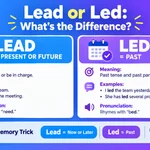
Lead or led? The correct choice depends on the tense of your sentence. Lead is the present-tense form of the verb meaning “to guide” or “to be in charge.” Led is the past tense and past participle of that verb. For example, “I lead the team today” describes a current role, while “I led the team yesterday” describes a completed action.
Although these words look similar, they have different spellings and pronunciations when used as verbs. Therefore, learning one simple grammar rule can help you avoid a common spelling mistake.
| Word | Meaning | Example |
|---|---|---|
| Lead | Present-tense verb meaning to guide or direct | I lead the team. |
| Led | Past tense of lead | I led the team yesterday. |
| Lead | Future action after “will” | I will lead the meeting. |
| Led | Past participle used with have, has, or had | She has led several projects. |
| Lead | A type of metal | The pipe contained lead. |
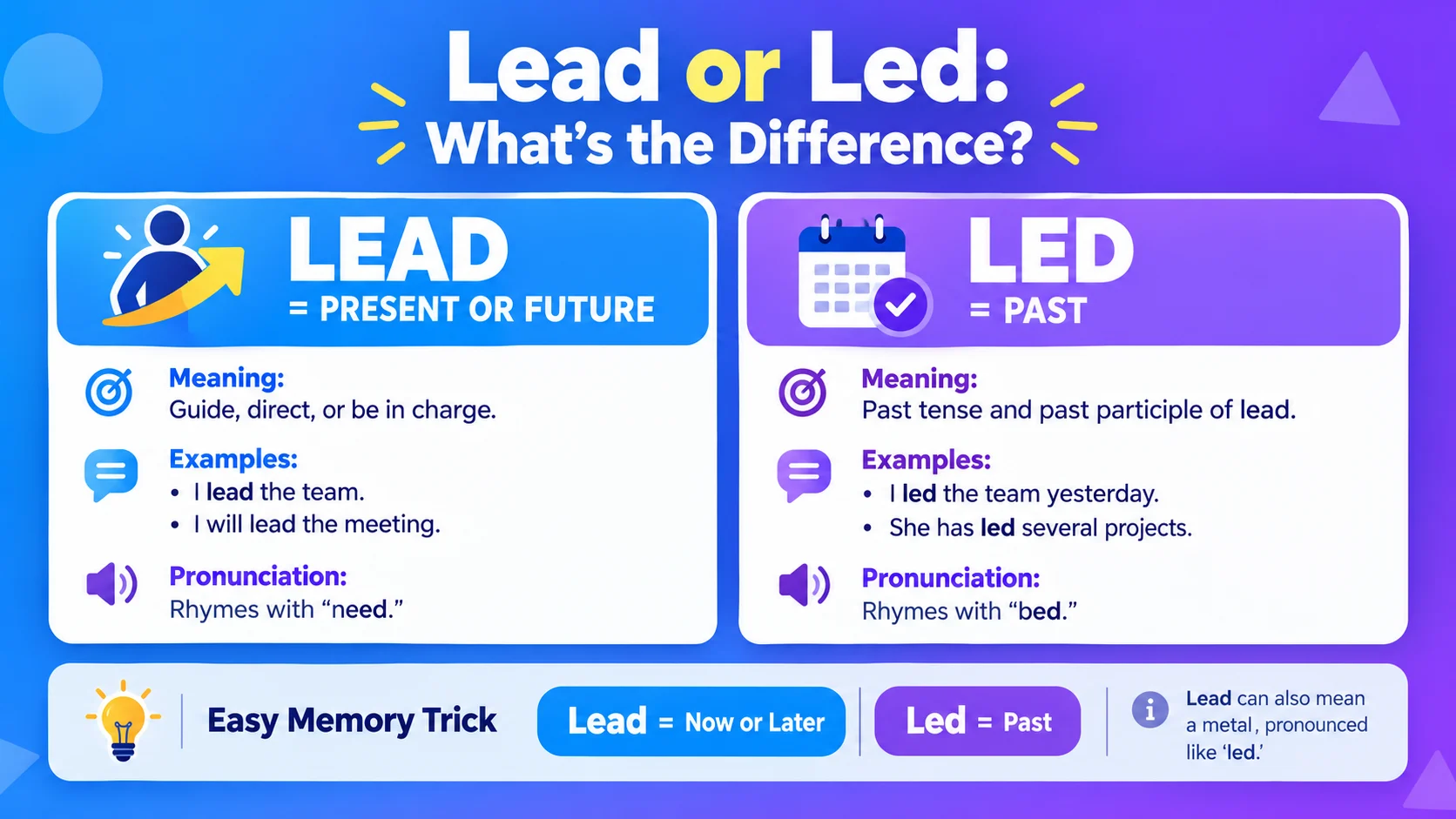
Easy rule: Use lead for present or future actions. Use led for completed past actions and as the past participle of the verb.
What Does Lead Mean?
The word lead, when pronounced like “leed,” is a verb that means to guide, direct, influence, or be in charge of someone or something.
For example, a teacher can lead a class, a manager can lead a team, and a captain can lead a group of players.
The word also appears in sentences about influencing an outcome. For instance, “Poor planning can lead to delays” means that poor planning can cause delays.
Here are some common uses of lead:
- Guide: Please lead us to the entrance.
- Manage: She will lead the new department.
- Influence: His advice may lead to a better decision.
- Be first: Our team continues to lead the competition.
- Show by example: Good managers lead by example.
Notice that lead often describes an action happening now, a general habit, or something expected to happen later. Therefore, the surrounding words help determine which form belongs in your sentence.
What Does Led Mean?
Led is the past tense and past participle of the verb lead. Use it when describing an action that happened in the past or when forming a perfect tense.
For example, “She led the meeting yesterday” describes a completed event. Similarly, “He has led the company for five years” uses led as a past participle.
Consider these additional examples:
- The guide led us through the museum.
- Our coach led the team to victory.
- Her presentation led to a useful discussion.
- They led the visitors to the main hall.
- He has led several successful projects.
- The decision had led to unexpected problems.
In each example, led refers to guiding, directing, or causing something in the past.
Remember: The standard past tense is led, not lead. Although adding “-ed” is common for regular verbs, lead is irregular.
Lead vs. Led: Key Differences
The main difference between lead and led is grammatical tense. However, pronunciation also helps distinguish them when you speak.
| Feature | Lead | Led |
|---|---|---|
| Verb tense | Present | Past |
| Past participle | Not applicable as the base form | Led |
| Pronunciation | “Leed” | “Led,” rhyming with “bed” |
| Example | I lead the discussion. | I led the discussion. |
| Time reference | Current, habitual, or future with a helping verb | Completed past action or perfect tense |
For example, compare these sentences:
Present: “Maya leads the project.”
Past: “Maya led the project last year.”
Future: “Maya will lead the project next year.”
The subject and basic action remain similar. Nevertheless, the verb form changes according to the time being described.
When Should You Use Lead?
Use lead when you describe a current action, a general responsibility, or an action that will happen in the future.
1. For Present Actions
Use lead when someone guides or directs people now.
- I lead the morning meetings.
- They lead the school debate team.
- Our supervisor leads the department.
These sentences describe current roles or repeated activities.
2. For Future Actions
After the helping verb will, use the base form lead.
- She will lead the next meeting.
- I will lead the discussion tomorrow.
- They will lead the project next month.
Therefore, do not write “She will led the meeting.” The correct sentence is “She will lead the meeting.”
3. After “To”
The infinitive form also uses lead.
- He wants to lead the team.
- We need someone to lead the group.
- She hopes to lead the company one day.
In these examples, lead follows “to,” so the past form led would be incorrect.
When Should You Use Led?
Use led when the action occurred in the past or when the verb appears in a perfect-tense construction.
1. For Completed Past Actions
Use led when describing something that already happened.
- She led the team last season.
- The guide led us to the exit.
- He led the meeting yesterday.
- Their research led to a new discovery.
Words such as yesterday, last year, and in 2024 often indicate a past event. However, the overall meaning of the sentence matters more than any single time word.
2. After Has, Have, or Had
Use led as the past participle in perfect-tense constructions.
- She has led the team for years.
- They have led several successful campaigns.
- He had led the company before retiring.
These sentences connect a past action to another time or describe experience accumulated over a period.
3. In Passive Sentences
Led can also appear in passive constructions.
- The group was led by an experienced teacher.
- The visitors were led into the auditorium.
- The investigation was led by a senior officer.
Here, the subject receives the action rather than performing it.
Lead or Led in Everyday Sentences
The easiest way to understand the difference is to compare similar sentences.
| Incorrect or Correct? | Sentence | Explanation |
|---|---|---|
| Correct | I lead the team every week. | Describes a regular responsibility. |
| Correct | I led the team last week. | Describes a completed past action. |
| Incorrect | She lead the meeting yesterday. | Use “led” for the past. |
| Correct | She led the meeting yesterday. | The action happened in the past. |
| Incorrect | He will led the project. | Use the base form after “will.” |
| Correct | He will lead the project. | Describes a future action. |
| Correct | They have led many projects. | Uses the past participle. |
| Incorrect | They have lead many projects. | Use “led” after “have.” |
As these examples show, the time and grammatical structure determine the correct spelling.
Lead vs. Led: Common Mistakes to Avoid
Even confident English writers sometimes confuse these words. Fortunately, a few simple checks can help.
Mistake 1: Writing Lead for a Past Action
Incorrect: “The coach lead the team to victory.”
Correct: “The coach led the team to victory.”
Because the victory happened in the past, led is the correct form.
Mistake 2: Using Led After Will
Incorrect: “I will led the presentation.”
Correct: “I will lead the presentation.”
After will, use the base form of the verb. The same rule applies to other base-form verbs, such as go, write, and speak.
Mistake 3: Using Lead After Has or Have
Incorrect: “She has lead several projects.”
Correct: “She has led several projects.”
The present perfect tense uses has or have followed by the past participle. In this case, that participle is led.
Mistake 4: Confusing Pronunciation With Spelling
The verb lead rhymes with “need,” while led rhymes with “bed.”
However, another word spelled lead refers to a metallic element and rhymes with “bed.” This shared spelling can cause confusion, especially when reading unfamiliar sentences.
Lead as a Noun: What Does It Mean?
The word lead has meanings beyond the verb “to guide.” As a noun, it can refer to a position of advantage, a clue, or a type of metal.
Lead Meaning an Advantage
In sports or competitions, a lead is an advantage over other competitors.
Example: “The runner has a five-second lead.”
Here, lead refers to the runner’s advantage, not an action.
Lead Meaning a Clue
In an investigation, a lead is information that may help someone discover the truth.
Example: “The detective found a new lead.”
In this context, lead is a noun, so it is not replaced with led.
Lead Meaning a Metal
Lead is also the name of a heavy chemical element with the symbol Pb.
Example: “The old paint contained lead.”
When it refers to the metal, lead is pronounced like “led.” However, its spelling remains lead.
How to Remember Lead vs. Led
A simple memory trick can help you choose the correct word.
Lead = now or later.
Led = past.
For example:
- Today, I lead the team.
- Yesterday, I led the team.
- Tomorrow, I will lead the team.
You can also replace the verb with guide or guided.
If “guided” fits the sentence, led is often correct for a past action. For example, “She guided the group yesterday” matches “She led the group yesterday.”
By contrast, “She will guide the group tomorrow” matches “She will lead the group tomorrow.”
This substitution is especially useful when you are unsure about the tense.
Lead vs. Led in Professional and Academic Writing
Choosing the correct form matters in emails, reports, essays, business documents, and professional biographies.
For example:
- Current responsibility: “I lead a team of five employees.”
- Previous responsibility: “I led a team of five employees.”
- Future responsibility: “I will lead a new department.”
- Completed experience: “I have led several major projects.”
These small differences communicate when an action occurred and whether it continues.
Therefore, review the verb whenever a sentence refers to leadership, management, guidance, or an outcome caused by an earlier action.
Frequently Asked Questions
Is it lead or led?
Both words are correct, but they serve different grammatical purposes. Lead is the present-tense verb, while led is its past tense and past participle. Choose the form that matches your sentence’s tense.
Is led the past tense of lead?
Yes. Led is the standard past tense of the verb lead, meaning to guide, direct, or be in charge. For example, “She led the team yesterday” describes a completed action.
Should I write “I lead” or “I led”?
Use “I lead” for a current or regular responsibility. In contrast, use “I led” when describing an action that happened in the past. For example, “I led the meeting yesterday.”
Is it “will lead” or “will led”?
The correct phrase is “will lead.” After the helping verb will, English uses the base form of the main verb. Therefore, “She will lead the project” is correct, while “She will led the project” is incorrect.
Is it “has lead” or “has led”?
The correct form is “has led.” The word has requires the past participle in a present perfect construction. For example, “He has led the organization for three years” is grammatically correct.
How do you pronounce lead and led?
When lead means “to guide,” it rhymes with “need.” Led rhymes with “bed.” However, lead can also refer to a metal, and that noun rhymes with “bed,” just like led.
Can lead be a noun?
Yes. Lead can refer to an advantage in a competition, a clue in an investigation, or the metal with the chemical symbol Pb. These noun meanings are different from the verb meaning “to guide.”
What is an easy trick to remember lead and led?
Remember lead for the present and led for the past. You can also substitute “guide” or “guided.” If “guided” fits a completed past action, led is usually the correct choice.
Conclusion
Lead or led? The right choice depends on when the action happens. Use lead for present responsibilities, future plans, and actions that follow “will.” In contrast, led describes completed past actions and appears after helping verbs such as “has,” “have,” and “had.” Remember that lead can also refer to a clue, an advantage, or a type of metal. These meanings depend on context, so read the full sentence before choosing. With a little practice, you can avoid common spelling mistakes and write more confidently. Keep this simple rule in mind: lead for now or later, led for the past.