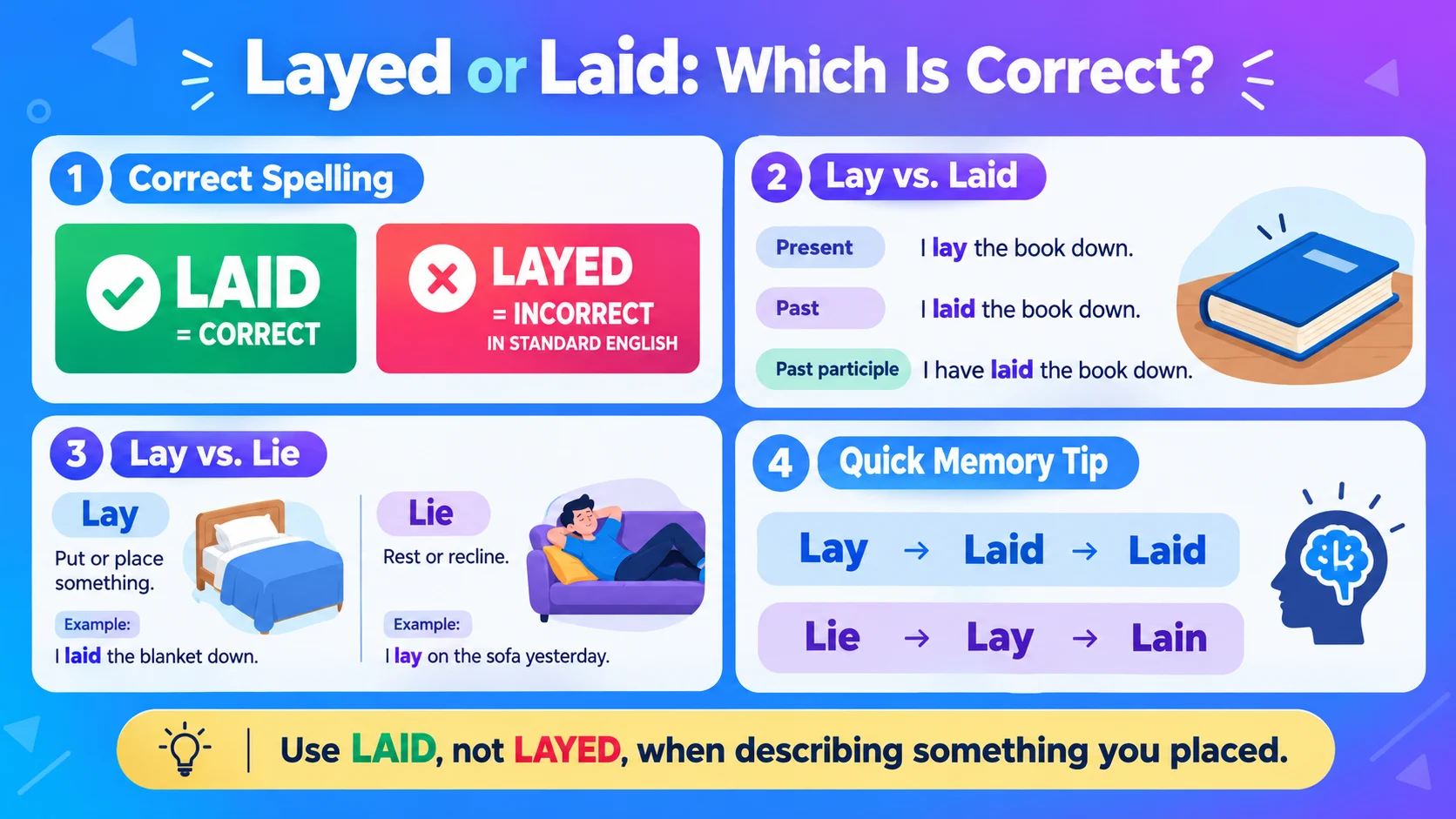
Laid is the correct spelling, while layed is generally incorrect in standard English. Laid is the past tense and past participle of the verb lay, which means to put or place something somewhere. For example, “She laid the book on the table” is correct.
However, English also has the verb lie, which means to rest or recline. Its past tense is lay, as in “I lay on the couch yesterday.” Although these forms look similar, each has a different use. Understanding the difference between layed or laid will help you write more clearly and avoid a common grammar mistake.
Laid is the correct spelling when you mean the past tense or past participle of lay, meaning to put or place something.
| Word | Correct? | Explanation |
|---|---|---|
| Laid | Yes | Past tense and past participle of lay |
| Layed | No, in standard usage | Common misspelling of laid |
| Lay | Yes | Present tense of lay; also the past tense of lie |
| Lie | Yes | To rest or recline |
| Lain | Yes | Past participle of lie when meaning to rest |
For example, write “He laid the keys on the counter,” not “He layed the keys on the counter.”
However, if you mean that someone rested, the correct sentence is “He lay on the couch yesterday.”
What Does Laid Mean?
Laid is the past tense and past participle of lay. The verb means to put, place, or position something somewhere.
For example, you might lay your phone on a desk, lay a blanket over a bed, or lay a foundation for a building. Once the action has happened, you use laid.
Consider these examples:
- She laid her jacket on the chair.
- He laid the baby gently in the crib.
- They laid the foundation for a new house.
- I have laid all the documents on your desk.
- The hen has laid three eggs.
In each sentence, someone or something places an object or produces an egg. Therefore, laid is the appropriate form.
The word also appears in expressions such as “laid the groundwork,” meaning established a basis for something. Similarly, “laid out the plan” means arranged or presented the details.
Is Layed a Real Word?
Layed is not the standard modern English spelling of the past tense of lay. In ordinary writing, use laid instead.
The confusion makes sense because many English verbs form their past tense by adding -ed. For example, walk becomes walked, and clean becomes cleaned.
However, lay is an irregular verb. It does not follow that usual pattern.
- Present: lay
- Past: laid
- Past participle: laid
As a result, “I layed the book down” is considered incorrect in standard English. The correct version is “I laid the book down.”
Although you might encounter layed in informal writing or online discussions, it is best to avoid it in school assignments, professional documents, and published articles.
Lay vs. Laid: What Is the Difference?
The difference between lay and laid mainly concerns tense.
Lay is the present form of the verb that means to put or place something. Laid is its past tense and past participle.
| Tense | Example |
|---|---|
| Present | I lay the book on the desk every morning. |
| Past | I laid the book on the desk yesterday. |
| Present perfect | I have laid the book on the desk. |
| Past perfect | I had laid the book on the desk before leaving. |
| Future | I will lay the book on the desk tomorrow. |
Notice that lay takes an object in these examples. The book is the thing being placed.
Therefore, when you describe placing something now or regularly, use lay. When the action happened in the past, use laid.
Lay vs. Lie: Why People Get Confused
The biggest source of confusion is the separate verb lie, which means to rest or recline.
Unlike lay, this verb does not need a direct object. Its forms are different:
| Verb Form | Lay (Put or Place) | Lie (Rest or Recline) |
|---|---|---|
| Present | lay | lie |
| Present participle | laying | lying |
| Past | laid | lay |
| Past participle | laid | lain |
For example, you lay a blanket on the bed, but you lie on the bed.
The past tense changes the pattern. You laid a blanket on the bed, but you lay on the bed yesterday.
This distinction explains why “I layed on the couch” is incorrect. If you mean that you rested on the couch, the standard form is “I lay on the couch.”
Examples of Lay and Lie
Correct uses of lay:
- I lay my phone beside my laptop every evening.
- She laid the papers on the table.
- They have laid new flooring throughout the house.
Correct uses of lie:
- I lie down when I feel tired.
- He lay on the grass yesterday.
- She has lain in bed all morning.
Although the forms can feel confusing at first, focus on the action. If someone places something, use lay or laid. If someone rests, use lie, lay, or lain, depending on the tense.
Is It “I Laid Down” or “I Lay Down”?
The answer depends on what you mean.
If you mean that you reclined or rested, “I lay down” is the standard past-tense form.
For example:
- Correct: I lay down for a nap yesterday.
- Incorrect in standard usage: I layed down for a nap yesterday.
However, laid down is correct when you place an object.
- Correct: I laid down my phone.
- Correct: She laid the baby down for a nap.
- Correct: He laid down the rules before the meeting.
In these examples, phone, baby, and rules are objects receiving the action.
You may hear people say “I laid down” when they mean “I lay down.” That usage is common in casual speech, but careful standard writing distinguishes the two verbs.
Common Examples of Laid in Sentences
The following examples show how to use laid correctly in everyday English.
Everyday Actions
- She laid her keys beside the door.
- I laid my clothes on the bed.
- He laid the package on the counter.
- We laid the towels in the bathroom.
Work and School
- The teacher laid the books on the desk.
- The team laid out its plans for the project.
- The workers laid the concrete yesterday.
- She has laid the documents in the correct order.
Eggs and Construction
- The hen laid an egg this morning.
- The builders laid the foundation last week.
- Workers laid new pipes beneath the road.
- The contractor has laid the floor tiles.
In all these examples, laid describes a completed action involving placement or an established result.
Common Mistakes to Avoid
Even experienced writers sometimes confuse these forms. Fortunately, a few simple corrections can prevent most errors.
| Incorrect Sentence | Correct Sentence |
|---|---|
| I layed the book on the desk. | I laid the book on the desk. |
| She layed the baby in the crib. | She laid the baby in the crib. |
| I laid on the sofa yesterday. | I lay on the sofa yesterday. |
| He has layed the papers out. | He has laid the papers out. |
| The dog laid in the grass yesterday. | The dog lay in the grass yesterday. |
The third and fifth examples involve lie, meaning to rest. Therefore, the past tense is lay, not laid.
By contrast, the first, second, and fourth sentences involve placing something. In those cases, laid is correct.
How to Remember Laid vs. Layed
A simple memory trick can help you choose the right spelling.
Remember: lay → laid → laid.
The verb lay uses laid for both the past tense and past participle. It does not use layed in standard modern English.
Next, keep the separate lie pattern in mind:
Lie → lay → lain.
This pattern applies when someone or something rests or reclines.
Try asking yourself two questions before writing:
- Am I describing someone placing something?
- Or am I describing someone resting?
If the action involves placing something, choose lay or laid. If it involves resting, choose lie, lay, or lain based on the tense.
With practice, this simple distinction becomes easier to remember.
Frequently Asked Questions
Is it layed or laid?
Laid is correct in standard English when you mean the past tense or past participle of lay. For example, “She laid the book on the table” is correct, while “She layed the book on the table” is not.
Is layed ever correct?
Layed is not the standard spelling of the past tense of lay in modern English. In ordinary writing, use laid. If you encounter layed online, it is usually a spelling mistake.
What is the past tense of lay?
The past tense of lay, meaning to put or place something, is laid. For example, “I lay the keys on the desk every day” becomes “I laid the keys on the desk yesterday.”
Is “I layed down” correct?
No. If you mean that you reclined or rested, write “I lay down.” The verb lie changes to lay in the past tense. However, “I laid the book down” is correct because the book is an object.
Is it “I laid down” or “I lay down”?
Use “I lay down” when describing yourself resting in the past. Use “I laid down” when you mean you placed something down, although the sentence should usually identify that object for clarity.
What is the difference between lay and lie?
Lay means to put or place something and requires an object. Lie means to rest or recline and does not require an object. Their past forms differ: laid for lay and lay for lie.
Is laid the past tense and past participle?
Yes. Laid serves as both the past tense and the past participle of lay. For example, “She laid the book down” uses the past tense, while “She has laid the book down” uses the past participle.
How do I remember lay, laid, and lain?
Remember two separate patterns: lay → laid → laid means to put or place something, while lie → lay → lain means to rest or recline. Keeping these patterns separate helps prevent common spelling and grammar mistakes.
Conclusion
Laid is the correct spelling, while layed is generally a misspelling in standard English. Use laid when describing something you put or placed somewhere, as in “She laid the book on the table.” However, remember that lie means to rest or recline, and its past tense is lay. Therefore, “I lay on the sofa yesterday” is correct. The easiest way to remember the difference is to separate the two patterns: lay, laid, laid for placing something and lie, lay, lain for resting. With this simple rule, you can choose the right word confidently.

Andrew Morris is a writer at Meaninga.com who specializes in word meanings, slang, idioms and modern language trends. He creates clear, accurate and easy to understand content for everyday readers.