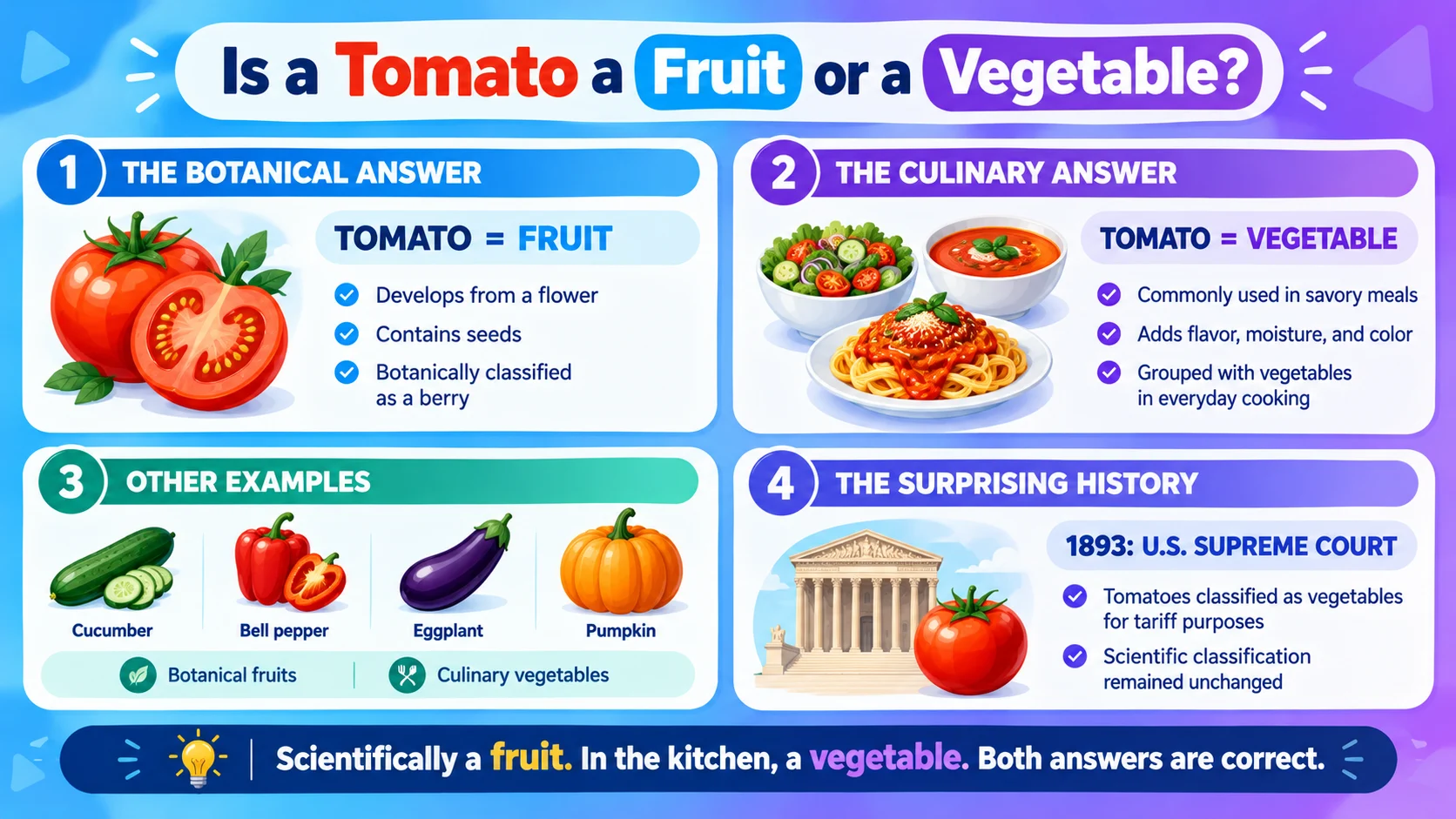
Is a tomato a fruit or a vegetable? The answer is both, depending on how you classify it. Botanically, a tomato is a fruit because it develops from a flower and contains seeds. However, cooks and nutrition experts generally treat tomatoes as vegetables because they appear in savory dishes such as salads, soups, sauces, and sandwiches. Therefore, neither answer is completely wrong. The difference comes down to whether you use the scientific definition or the culinary definition. Once you understand these two classifications, the tomato debate becomes much easier to explain.
Is a Tomato a Fruit or a Vegetable?
A tomato is both a fruit and a vegetable, depending on the classification system. In botany, it is a fruit because it develops from a flower and contains seeds. In cooking, people treat it as a vegetable because of its savory flavor and common use in meals.
| Classification | Is a Tomato a Fruit or a Vegetable? | Reason |
|---|---|---|
| Botanical | Fruit | It develops from a flower and contains seeds. |
| Culinary | Vegetable | People commonly use it in savory dishes. |
| Everyday language | Usually a vegetable | It is often served with meals rather than desserts. |
| U.S. legal history | Vegetable for tariff purposes | A Supreme Court ruling addressed how tomatoes were classified in trade. |
Why Is a Tomato Botanically a Fruit?
From a scientific perspective, a tomato is a fruit. To understand why, you need to know how botanists define this plant structure.
A botanical fruit develops from the ovary of a flower and usually contains seeds. After a tomato flower is pollinated, its ovary grows into the fleshy tomato that people eat.
As the tomato develops, its seeds form inside the fruit. These seeds can produce new tomato plants under suitable conditions.
For example, apples, cucumbers, peppers, and pumpkins also qualify as botanical fruits. Although these foods look and taste different, they share important features related to how they develop.
The tomato follows the same basic pattern. Its flowers produce fruits, and those fruits contain seeds.
Therefore, scientists classify tomatoes as fruits based on their structure and development, not their sweetness or the way people prepare them.
What Makes a Fruit Different From a Vegetable?
The main difference comes from botanical classification.
A fruit develops from a flower’s ovary after fertilization or seed development. By contrast, the word vegetable is a broad culinary term rather than one precise botanical category.
Vegetables can come from several parts of a plant. For example:
- Roots: Carrots, beets, and radishes.
- Leaves: Spinach, lettuce, and cabbage.
- Stems: Asparagus and celery.
- Flowers: Broccoli and cauliflower.
- Seeds: Peas and sweet corn.
- Fruits used as vegetables: Tomatoes, peppers, cucumbers, and eggplants.
Consequently, a plant food can be a fruit scientifically while still being called a vegetable in everyday cooking.
Why Is a Tomato Considered a Vegetable in Cooking?
Although science classifies tomatoes as fruits, cooks usually treat them as vegetables. The reason is simple: culinary classifications focus on flavor, texture, and how people use food.
Tomatoes have a mildly sweet, tangy, and savory flavor. In addition, they work well in dishes that people traditionally prepare as main courses, side dishes, or sauces.
Consider some familiar examples:
- Tomato soup
- Fresh tomato salad
- Pasta with tomato sauce
- Tomato and cheese sandwiches
- Salsa and other savory dips
- Roasted tomatoes served with dinner
These dishes rarely resemble traditional fruit desserts. Instead, tomatoes contribute flavor, moisture, acidity, and color to savory meals.
However, tomatoes can also taste sweet when fully ripe. People sometimes eat them raw as snacks, and certain varieties work well in sweet-and-savory recipes.
Even so, their usual role in the kitchen explains why most people call them vegetables.
What Is the Difference Between Botanical and Culinary Classification?
Botanical and culinary classifications answer different questions. Botany asks how a plant part develops, while cooking focuses on how people prepare and eat it.
As a result, the same food can have two correct classifications.
| Food | Botanical Classification | Common Culinary Classification |
|---|---|---|
| Tomato | Fruit | Vegetable |
| Cucumber | Fruit | Vegetable |
| Bell pepper | Fruit | Vegetable |
| Eggplant | Fruit | Vegetable |
| Pumpkin | Fruit | Vegetable |
| Apple | Fruit | Fruit |
| Carrot | Root | Vegetable |
| Spinach | Leaf | Vegetable |
| Broccoli | Flower structure | Vegetable |
| Celery | Mainly leaf stalks | Vegetable |
This comparison shows why the debate exists. Several foods that people call vegetables are technically fruits.
Nevertheless, everyday food categories remain useful. They help people plan meals, choose ingredients, and understand how foods fit into familiar recipes.
The key distinction is that botanical classification describes plant structure, while culinary classification describes food use.
Is a Tomato a Berry?
Surprisingly, a tomato is also classified as a botanical berry.
In everyday language, people often use the word berry for small, sweet fruits such as strawberries, raspberries, and blueberries. However, botanists use a more specific definition.
A botanical berry is a fleshy fruit that develops from a single flower’s ovary and generally contains seeds within its fleshy interior.
Tomatoes fit this definition. Their fleshy walls surround the seeds, and the fruit develops from the flower’s ovary.
Other examples of botanical berries include grapes and bananas. Although these fruits differ greatly in size and taste, their structures meet the botanical criteria.
Interestingly, strawberries are not true botanical berries under this definition. They develop differently, with their small surface structures representing the actual fruits.
Therefore, a tomato can be a fruit, a berry, and a culinary vegetable at the same time. Each term describes a different aspect of the food.
The Famous Tomato Supreme Court Case
The tomato debate has a surprising place in American legal history. In 1893, the U.S. Supreme Court considered whether tomatoes should be treated as fruits or vegetables for tariff purposes.
The case was Nix v. Hedden. It involved an importer who argued that tomatoes should receive the treatment applied to fruits rather than vegetables under the relevant tariff law.
The dispute arose because the law imposed import duties on certain vegetables but treated fruits differently. The classification mattered because it affected the amount of duty that importers had to pay.
The Court considered how people commonly understood and used tomatoes. Since people generally served tomatoes with meals rather than as dessert, the Court treated them as vegetables for the purposes of that tariff law.
However, the ruling did not change the scientific definition of a fruit.
Botanically, tomatoes remained fruits because they develop from flowers and contain seeds. The legal decision addressed a specific trade question, not plant biology.
As a result, the case is often mentioned whenever people ask whether a tomato is a fruit or a vegetable.
Are Tomatoes Fruits or Vegetables According to Nutrition Experts?
In everyday nutrition guidance, tomatoes are commonly grouped with vegetables. This approach reflects how people usually eat them and how food groups support meal planning.
For example, tomatoes can contribute vitamin C, fiber, potassium, and other nutrients to a balanced diet. They also contain lycopene, a natural pigment that gives many red tomatoes their color.
Lycopene belongs to a group of plant compounds called carotenoids. In addition, tomatoes provide water and have relatively few calories when eaten without heavy sauces or added fats.
Their classification in a nutrition guide does not mean they stop being botanical fruits. Instead, nutrition systems use practical food categories to help people plan varied diets.
Therefore, the word vegetable can make sense in a nutritional or culinary discussion even when the scientific answer is fruit.
Are Cherry Tomatoes and Grape Tomatoes Fruits Too?
Yes. Cherry tomatoes and grape tomatoes are fruits for the same botanical reasons as larger tomatoes.
Both types develop from flowers and contain seeds. Their smaller size does not change their scientific classification.
However, their shapes, textures, and flavors can differ. Cherry tomatoes are often round and juicy, while grape tomatoes tend to have an elongated shape and firmer flesh.
People commonly add both varieties to salads, lunch boxes, pasta dishes, and snack plates. Consequently, they are usually treated as vegetables in the kitchen.
The same rule applies to yellow tomatoes, green tomatoes, heirloom tomatoes, and many other cultivated varieties.
Regardless of color, shape, or size, a tomato’s botanical classification depends on how it develops rather than its appearance.
Other Fruits That People Commonly Call Vegetables
Tomatoes are not the only foods that fit into both categories. Several familiar ingredients are botanical fruits but culinary vegetables.
Cucumbers
Cucumbers develop from flowers and contain seeds. Nevertheless, people usually slice them into salads, add them to sandwiches, or serve them as savory snacks.
Bell Peppers
Bell peppers contain seeds and develop from flowers. Although their flavors can be sweet, cooks commonly use them in stir-fries, stuffed dishes, salads, and sauces.
Eggplants
Eggplants are botanical fruits. However, their firm texture and savory flavor make them popular in dishes such as curries, casseroles, and roasted vegetable plates.
Pumpkins
Pumpkins are also fruits from a botanical perspective. Still, people commonly use them as vegetables in soups, roasted dishes, and savory recipes, even though they also appear in sweet pies.
Avocados
Avocados develop from flowers and contain a seed, so they qualify as fruits. However, their creamy texture and mild flavor make them common ingredients in salads, spreads, and savory dips.
These examples reinforce the same principle: a food’s scientific classification does not always match its everyday culinary category.
Common Misconceptions About Tomatoes
Several misunderstandings keep the tomato debate alive. Understanding the facts makes the answer easier to remember.
Misconception 1: Fruits must taste sweet.
Not necessarily. Botanical classification depends on plant development, not sweetness. Tomatoes can taste tangy or savory and still qualify as fruits.
Misconception 2: Cooking turns a fruit into a vegetable.
Cooking does not change a tomato’s botanical classification. Tomato sauce and fresh tomatoes come from the same type of fruit, even though people use them differently.
Misconception 3: The Supreme Court proved that tomatoes are scientifically vegetables.
The 1893 decision concerned a tariff law and common culinary usage. It did not overturn the botanical definition.
Misconception 4: Every food called a vegetable is a botanical vegetable.
That is incorrect. Cucumbers, peppers, eggplants, and tomatoes are all botanical fruits commonly treated as vegetables.
Misconception 5: Tomatoes cannot be both fruits and vegetables.
They can, because the two labels use different classification systems. One describes the plant’s structure, while the other describes how people use the food.
Frequently Asked Questions
Is a tomato a fruit or a vegetable?
A tomato is botanically a fruit because it develops from a flower and contains seeds. However, cooks generally treat it as a vegetable because people commonly use it in savory meals, salads, sauces, and soups.
Why is a tomato technically a fruit?
A tomato is technically a fruit because it develops from the ovary of a flower and contains seeds. These features meet the botanical definition of a fruit, regardless of its flavor or how people prepare it.
Why do people call tomatoes vegetables?
People call tomatoes vegetables because they commonly appear in savory dishes rather than desserts. In cooking, the term vegetable describes how an ingredient is used, not necessarily the part of the plant from which it develops.
Is a tomato a berry?
Yes. Botanically, a tomato is a type of berry because it develops from a single flower’s ovary and has a fleshy interior containing seeds. However, everyday language uses the word berry differently.
Did the Supreme Court rule that tomatoes are vegetables?
Yes, in 1893, the U.S. Supreme Court treated tomatoes as vegetables for the purposes of a tariff law. The decision reflected common culinary usage and did not change their botanical classification as fruits.
Are cherry tomatoes fruits or vegetables?
Cherry tomatoes are botanical fruits because they develop from flowers and contain seeds. Nevertheless, people usually treat them as vegetables when adding them to salads, pasta, sandwiches, and other savory dishes.
Are cucumbers and peppers fruits too?
Yes. Cucumbers and peppers are botanical fruits because they develop from flowers and contain seeds. However, cooks commonly classify them as vegetables because they are usually used in savory meals.
Is a tomato a fruit according to science?
Yes. Science classifies a tomato as a fruit because of how it develops from a flowering plant. More specifically, tomatoes are fleshy botanical berries that contain seeds inside their fruit structure.
Conclusion
So, is a tomato a fruit or a vegetable? The answer depends on the context. Botanically, a tomato is a fruit because it develops from a flower and contains seeds. In the kitchen, however, people generally treat it as a vegetable because of its role in savory meals. The famous 1893 Supreme Court case also classified tomatoes as vegetables for tariff purposes, but it did not change their scientific identity. Interestingly, tomatoes are also botanical berries. Therefore, you can confidently call a tomato either a fruit or a vegetable, provided you understand which classification you mean.