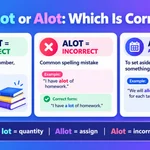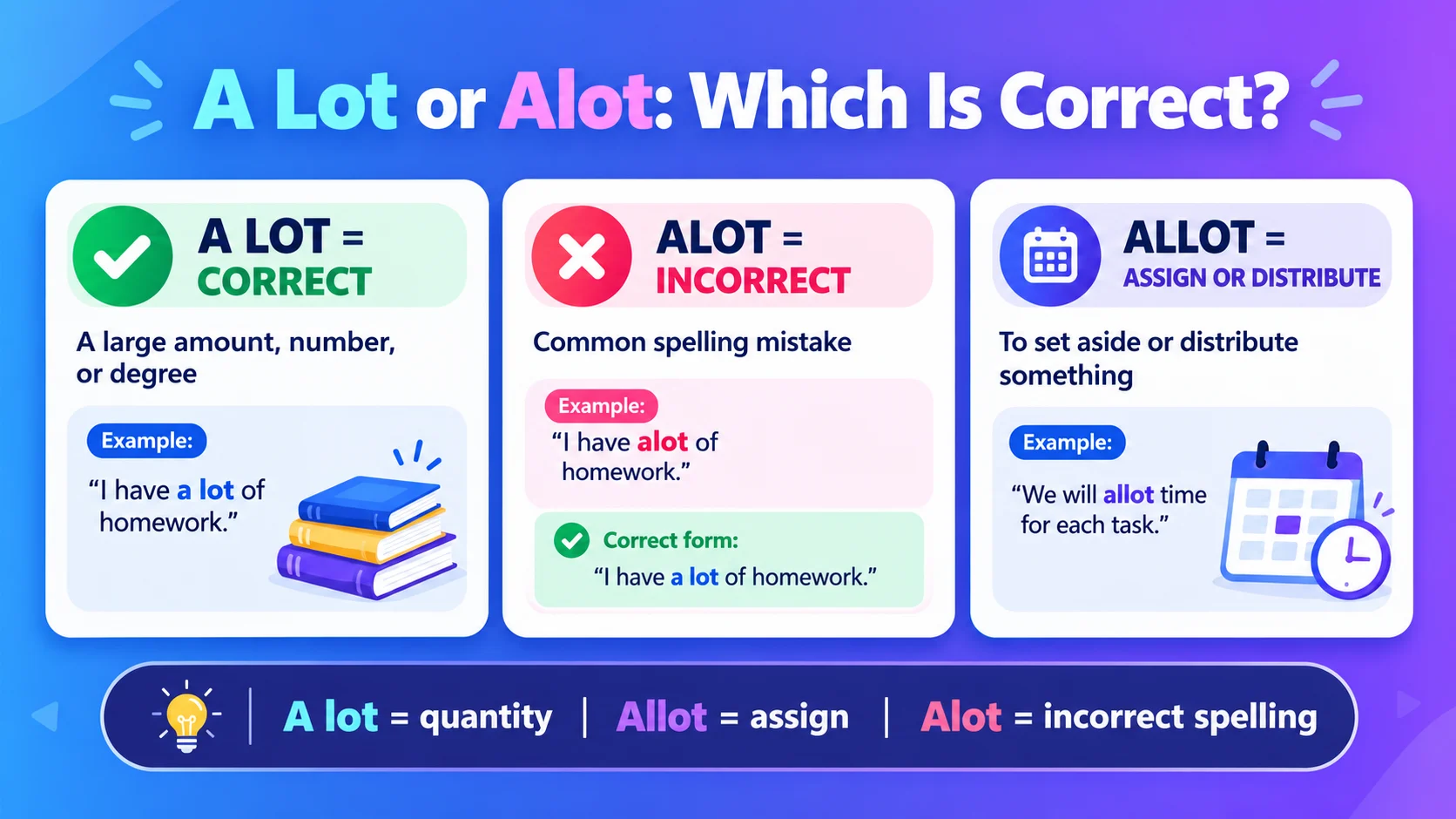
A lot or alot? The correct spelling is a lot, written as two separate words. Although many people write “alot” in text messages, emails, and social media posts, standard English treats it as a spelling mistake. The phrase a lot means a large amount, a large number, or very much. For example, you can say, “I have a lot of work today” or “I enjoy reading a lot.” However, allot is a different word that means to assign or distribute something. Understanding these differences will help you write clearly and avoid a common grammar mistake.
A Lot or Alot?
A lot is the correct spelling when you mean “a large amount,” “many,” “very much,” or “often.” The spelling alot is considered incorrect in standard English. Meanwhile, allot is a separate verb meaning to assign or distribute something for a specific purpose.
| Word | Correct? | Meaning | Example |
|---|---|---|---|
| A lot | Yes | A large amount or very much | I have a lot of homework. |
| Alot | No | Common misspelling of a lot | I have alot of homework. |
| Allot | Yes | To assign or distribute | We will allot time for each task. |
Is It A Lot or Alot?
The correct form is a lot, with a space between the two words. Although “alot” may look natural because the phrase has a single meaning, standard English does not recognize it as the correct spelling. <Cite refs={[“turn392002search0″,”turn392002search2”]}/>
For example:
- Correct: I learned a lot from that experience.
- Incorrect: I learned alot from that experience.
- Correct: She has a lot of friends.
- Incorrect: She has alot of friends.
The mistake is common because people often treat familiar phrases as single words. However, a space is still necessary even when the phrase functions as one unit in a sentence.
Therefore, whenever you want to express a large quantity or degree, write a lot rather than “alot.”
What Does A Lot Mean?
The phrase a lot has several related meanings. It can describe a large quantity, a large number, or something that happens frequently or to a great degree.
1. A Lot Means a Large Amount
Use a lot of before a noun when you want to describe a large quantity or number.
Examples:
- I have a lot of work to finish.
- She bought a lot of groceries.
- We need a lot of water for the trip.
- There were a lot of people at the concert.
In these examples, a lot of tells the reader that the amount or number is large.
2. A Lot Means Very Much
You can also use a lot without a noun to describe how strongly you feel or how much something affects you.
For example:
- I love my family a lot.
- Thank you a lot for your help.
- This new phone costs a lot.
- That movie made me laugh a lot.
Here, the phrase describes degree rather than a specific collection of things. As a result, the meaning depends on the verb or adjective in the sentence.
3. A Lot Can Mean Often
In some sentences, a lot means frequently or many times.
Examples:
- I exercise a lot.
- They travel a lot during the summer.
- He talks about his new job a lot.
- We see each other a lot.
Notice that you do not need to add of when a lot describes how frequently an action happens.
How to Use A Lot in a Sentence
Using a lot correctly becomes easier when you identify what you want to describe.
Use A Lot of Before a Noun
When a noun follows the phrase, use a lot of to describe a large quantity or number.
Examples:
- She has a lot of books.
- We spent a lot of money.
- There is a lot of traffic today.
- He has a lot of patience.
This construction works with plural countable nouns, such as books, and uncountable nouns, such as money and traffic.
Use A Lot Without Of
When you describe an action, feeling, or degree, you usually do not need of.
Examples:
- I study a lot.
- She smiles a lot.
- We enjoyed the trip a lot.
- This exercise helps a lot.
However, adding of in these examples would usually make the sentence incorrect or change its structure.
Use A Lot in Questions
You can also use the phrase in questions.
Examples:
- Do you travel a lot?
- Does she have a lot of homework?
- Did you learn a lot?
- Are there a lot of restaurants nearby?
These questions sound natural in everyday English. In more formal writing, alternatives such as many, much, or a large number of may sometimes fit better.
A Lot vs. Alot vs. Allot
Although these three forms look and sound similar, they serve different purposes.
A Lot
A lot refers to a large amount, a large number, or a high degree.
Example: “I spend a lot of time reading.”
Alot
Alot is a common spelling error. You should replace it with a lot in standard writing.
Example:
- Incorrect: “She likes music alot.”
- Correct: “She likes music a lot.”
Allot
Allot is a real word. It is a verb meaning to assign, distribute, or set aside something for a particular purpose. <Cite refs={[“turn392002search0″,”turn392002search4”]}/>
Examples:
- The teacher will allot ten minutes for the quiz.
- We need to allot more money to the project.
- Each participant will be allotted a specific amount of time.
The easiest way to remember the difference is this: a lot describes quantity, while allot describes assigning a share.
Common Mistakes With A Lot
Even experienced writers sometimes confuse these expressions. Fortunately, a few simple rules can help you avoid the most common errors.
Mistake 1: Writing Alot as One Word
Incorrect: “I have alot of things to do.”
Correct: “I have a lot of things to do.”
Always leave a space between a and lot. This rule applies to formal documents, school assignments, emails, and everyday writing.
Mistake 2: Using Allot When You Mean A Lot
Incorrect: “I enjoyed the concert allot.”
Correct: “I enjoyed the concert a lot.”
The first sentence uses a verb where the writer needs an expression of degree. Therefore, use a lot when you mean “very much.”
Mistake 3: Adding Of After A Lot Unnecessarily
Incorrect: “I enjoy swimming a lot of.”
Correct: “I enjoy swimming a lot.”
Use a lot of when a noun follows, as in “I have a lot of free time.” Otherwise, a lot can stand alone.
Mistake 4: Assuming A Lot Is Always Formal
Although a lot is correct, it can sound informal in academic or professional writing. In those settings, you may prefer a more precise alternative.
For example, instead of “The study found a lot of errors,” you could write, “The study found numerous errors.”
Better Alternatives to A Lot
Sometimes, replacing a lot can make your writing clearer or more professional. The best alternative depends on the meaning you want to express.
| Meaning | Alternative | Example |
|---|---|---|
| Many things or people | Numerous | Numerous students attended. |
| A large amount | A great deal of | We need a great deal of time. |
| Many items | Several | She purchased several books. |
| More than enough | Plenty of | We have plenty of food. |
| Frequently | Often | He often visits his grandparents. |
| To a high degree | Significantly | The results improved significantly. |
For casual conversations, a lot remains perfectly natural. However, alternatives can make formal writing more precise and varied.
A Lot or Alot in Text Messages and Social Media
People sometimes type alot in text messages, comments, and social media posts because they write quickly. Nevertheless, the spelling remains nonstandard.
For example:
- Casual but correct: “I miss you a lot ❤️”
- Common mistake: “I miss you alot ❤️”
- Correct: “I use this app a lot.”
- Incorrect: “I use this app alot.”
In informal communication, readers may still understand the intended meaning. Even so, using the correct spelling helps your messages look polished and prevents the mistake from carrying into professional writing.
If you want your writing to remain clear across different settings, make a lot your default choice.
Frequently Asked Questions
Is a lot one word or two?
A lot is two words. The phrase contains the article a and the noun lot. Although people often combine them by mistake, standard English requires a space whenever the phrase means a large amount or degree.
Is alot a real word?
In standard English, alot is considered a misspelling, not the correct form of the expression. Use a lot when describing a large amount, a large number, or something that happens frequently.
Why do people write alot instead of a lot?
People often write alot because the phrase sounds like one unit when spoken. In addition, typing quickly can lead to spelling mistakes. However, the standard written form remains a lot, with a space.
What is the difference between a lot and allot?
A lot means a large quantity or very much, while allot means to assign or distribute something. For example, “I have a lot of work” describes quantity, whereas “We will allot time” describes assigning time.
Can I use a lot in formal writing?
Yes, a lot is grammatically correct, but it may sound informal in academic or professional writing. Depending on the sentence, alternatives such as numerous, many, or a great deal of may be more appropriate.
Is a lot of grammatically correct?
Yes. A lot of is correct before a noun when you mean a large amount or number. For example, “She has a lot of experience” and “They invited a lot of guests” are both grammatically correct.
Is thanks a lot correct?
Yes, “Thanks a lot” is a common expression that means “thank you very much.” However, depending on the context and tone, it can sometimes sound sarcastic. For a neutral alternative, you can simply say, “Thank you very much.”
Which is correct: I miss you alot or I miss you a lot?
“I miss you a lot” is correct because a lot must be written as two words. The sentence expresses a strong feeling of missing someone. Writing alot instead is a spelling mistake.
Conclusion
Remember, the correct spelling is a lot, not alot. Use this two-word phrase when describing a large amount, a large number, or something that happens frequently. For example, “I have a lot of work” and “I exercise a lot” are both correct. However, do not confuse a lot with allot, which means to assign or distribute something. Although the misspelling appears in casual messages, standard English still requires the space. When writing professionally, consider alternatives such as numerous, often, or a great deal of. With this simple rule, you can write more clearly and confidently.