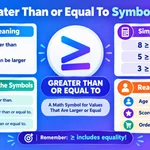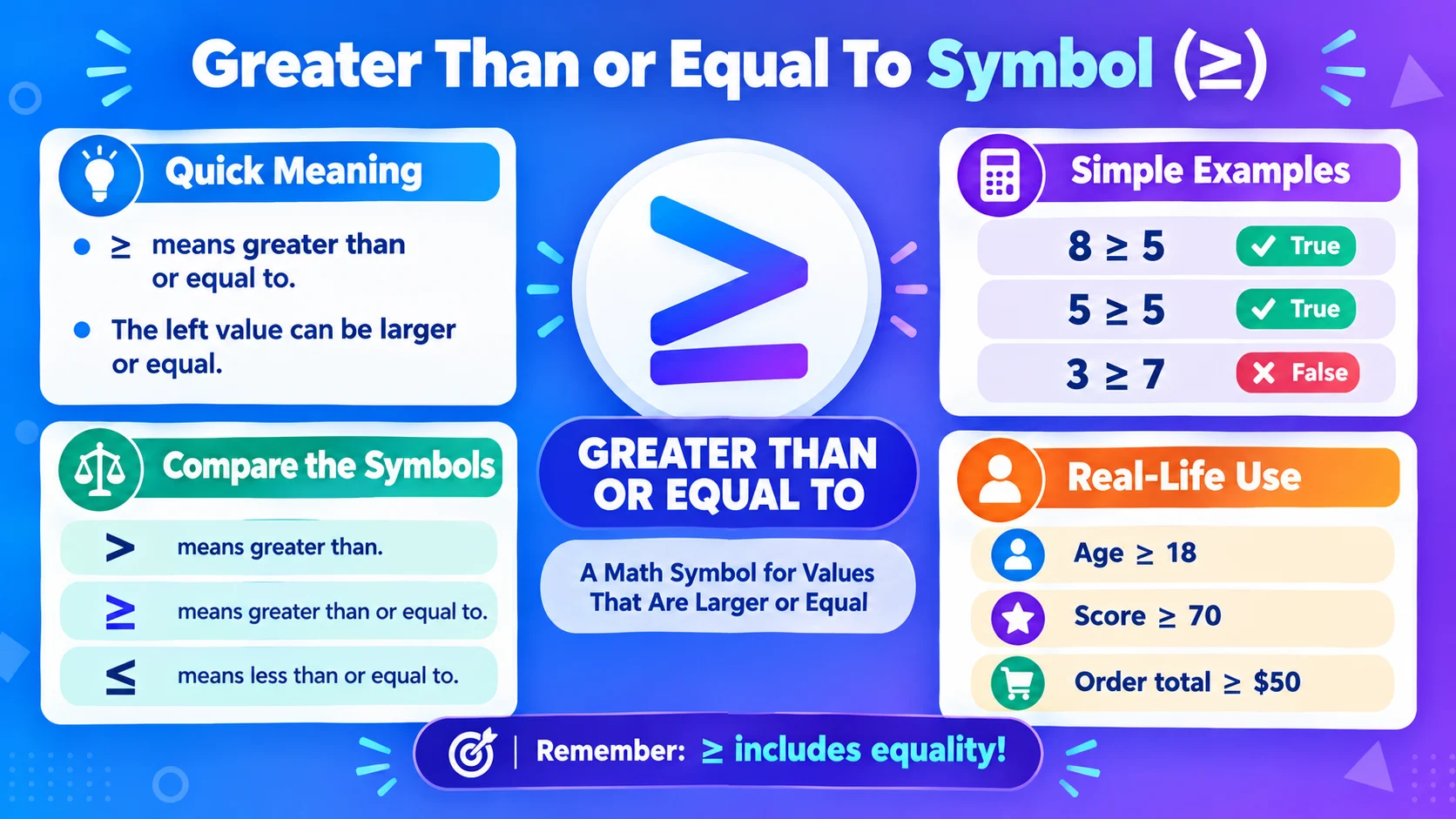
The ≥ symbol means “greater than or equal to.” It shows that the value on the left is either larger than or exactly equal to the value on the right. For example, (8 ≥ 5) is true.
The greater than or equal to symbol (≥) is a mathematical symbol used to show that one value is greater than or equal to another value. It means the value on the left can be larger than the value on the right or exactly the same.
For example, x ≥ 5 means that (x) can equal 5 or any number greater than 5. Therefore, 5, 6, 10, and 100 all satisfy this inequality.
The symbol appears in algebra, arithmetic, statistics, equations, inequalities, and computer-related work. Although it looks similar to the greater than sign, it includes equality as well. Understanding this small difference makes it easier to solve mathematical problems and read expressions correctly.
Quick Overview of the ≥ Symbol
| Feature | Details |
|---|---|
| Symbol | ≥ |
| Name | Greater than or equal to |
| Main purpose | Compare two values |
| Greater than sign | > |
| Equal sign | = |
| Unicode | U+2265 |
| HTML entity | ≥ |
| HTML decimal code | ≥ |
| LaTeX command | \geq |
The symbol combines the greater than sign with a line underneath it. That line indicates that equality is allowed, unlike the standard greater than sign.
What Is the Greater Than or Equal To Symbol?
The greater than or equal to symbol is ≥. It compares two values and shows that the first value is at least as large as the second.
In simple terms, the symbol represents two possible relationships:
- The left value is greater than the right value.
- Both values are equal.
For example:
- (10 ≥ 7) is true because 10 is greater than 7.
- (5 ≥ 5) is true because both values are equal.
- (3 ≥ 8) is false because 3 is smaller than 8.
Therefore, the symbol does not require the left number to be strictly larger. It only requires the left number to be equal to or larger than the right number.
How to Read the ≥ Symbol
You can read ≥ as “greater than or equal to.”
For example, the expression (x ≥ 10) is read as “x is greater than or equal to ten.”
This means that (x) can be 10 or any number larger than 10.
| Expression | How to Read It | Meaning |
|---|---|---|
| (7 ≥ 4) | Seven is greater than or equal to four | True |
| (6 ≥ 6) | Six is greater than or equal to six | True |
| (2 ≥ 9) | Two is greater than or equal to nine | False |
| (x ≥ 12) | x is greater than or equal to twelve | x can be 12 or more |
| (y ≥ 0) | y is greater than or equal to zero | y can be zero or positive |
In everyday language, you can think of the symbol as meaning “at least.” For instance, “You must be at least 18 years old” can be written as age ≥ 18.
Difference Between > and ≥
The greater than sign (>) and the greater than or equal to symbol (≥) look similar. However, they express different mathematical relationships.
The greater than sign only allows a value that is strictly larger. In contrast, the greater than or equal to symbol also allows both values to match.
| Symbol | Name | Meaning | Example |
|---|---|---|---|
| > | Greater than | The left value must be larger | (8 > 5) |
| ≥ | Greater than or equal to | The left value can be larger or equal | (8 ≥ 5) |
| = | Equal to | Both values must match | (5 = 5) |
| < | Less than | The left value must be smaller | (3 < 7) |
| ≤ | Less than or equal to | The left value can be smaller or equal | (4 ≤ 4) |
Consider the number 5. The statement (5 > 5) is false because 5 is not larger than itself. However, (5 ≥ 5) is true because equality is permitted.
This distinction becomes especially important when solving inequalities and interpreting minimum requirements.
Examples of the Greater Than or Equal To Symbol
The easiest way to understand the symbol is to examine it in different mathematical situations.
Example 1: Comparing Whole Numbers
Consider the expression:
[
12 ≥ 9
]
This statement is true because 12 is greater than 9.
Similarly:
[
6 ≥ 6
]
This statement is also true because both numbers are equal.
Example 2: Finding Possible Values of x
Suppose you have the inequality:
[
x ≥ 4
]
The possible whole-number values include 4, 5, 6, 7, and many more.
However, 3 does not satisfy the inequality because it is smaller than 4.
Example 3: Comparing Decimal Numbers
The symbol also works with decimals.
For example:
[
4.5 ≥ 4.2
]
This is true because 4.5 is greater than 4.2.
Likewise, (3.75 ≥ 3.75) is true because both values are equal.
Example 4: Using Negative Numbers
Negative numbers can also be compared with ≥.
For instance:
[
-2 ≥ -5
]
This statement is true because −2 is greater than −5. On a number line, −2 appears to the right of −5.
By contrast, (-7 ≥ -3) is false because −7 is smaller than −3.
How to Use ≥ in Algebra
In algebra, the greater than or equal to symbol appears in inequalities. An inequality describes a relationship between values without requiring them to be equal.
For example:
[
x + 3 ≥ 8
]
To solve this inequality, subtract 3 from both sides:
[
x ≥ 5
]
Therefore, every value of (x) that is 5 or greater satisfies the inequality.
Some possible solutions are 5, 6, 7, and 10. If decimal or fractional values are allowed, 5.5 and 6.25 also work.
The key rule is to perform the same operation on both sides when solving an inequality. However, if you multiply or divide both sides by a negative number, you must reverse the inequality sign.
For example:
[
-2x ≥ 8
]
Divide both sides by −2 and reverse the sign:
[
x ≤ -4
]
This gives the correct solution.
How ≥ Appears on a Number Line
A number line can help you visualize inequalities.
Consider:
[
x ≥ 3
]
The solution includes 3 and every number greater than 3. On a number line, you would mark 3 with a closed circle and shade or draw an arrow to the right.
The closed circle matters because the value 3 is included in the solution.
By contrast, (x > 3) uses an open circle at 3 because the number 3 itself is excluded.
This visual distinction makes it easier to remember how the two symbols work.
Real-Life Uses of the Greater Than or Equal To Symbol
The ≥ symbol is useful beyond classroom mathematics. It can represent minimum requirements, limits, thresholds, and conditions.
Age Requirements
A rule requiring someone to be at least 18 years old can be written as:
[
\text{Age} ≥ 18
]
This includes people who are exactly 18 as well as those who are older.
Minimum Scores
Suppose a student needs a score of at least 70 to pass an assessment.
[
\text{Score} ≥ 70
]
A score of 70 meets the requirement, while a score of 69 does not.
Spending Requirements
A store may offer free shipping on orders of $50 or more.
[
\text{Order total} ≥ $50
]
An order worth exactly $50 qualifies, as does an order worth $60.
Temperature Limits
A machine might need a temperature of at least 20°C to operate.
[
T ≥ 20^\circ C
]
In this case, a temperature of 20°C meets the condition. Higher temperatures also satisfy it.
These examples show why the symbol is useful whenever a rule includes a minimum value.
How to Type the Greater Than or Equal To Symbol
You can insert ≥ in documents, messages, spreadsheets, and mathematical expressions. The easiest method depends on the device or application you use.
Copy and Paste
The quickest method is to copy the symbol below:
≥
You can then paste it into a document, email, spreadsheet, or online form.
In Microsoft Word
In Word, type the Unicode value 2265 and then press Alt + X. Word converts the code into the greater than or equal to symbol.
You can also use Word’s Insert Symbol menu to find and insert it.
On Windows
Keyboard shortcuts can vary by application and keyboard configuration. If a numeric Alt code does not work, use the Character Map utility or copy and paste the symbol.
On Mac
On a Mac, you can use the Character Viewer to search for “greater than or equal to.” Select the symbol and insert it into your text.
Some keyboard layouts or applications also support direct shortcuts.
In HTML
Use the named HTML entity:
≥
Alternatively, use the decimal character reference:
≥
Both represent the same symbol, ≥.
In LaTeX
Use the command \geq in mathematical mode.
For example:
x \geq 5This displays the mathematical expression (x \geq 5).
Greater Than or Equal To Symbol in Programming
In programming, the equivalent comparison is commonly written as >= rather than the single-character symbol ≥.
For example, a condition in Python might look like this:
age = 18

if age >= 18:
    print("Requirement met")
The condition is true when age equals 18 or exceeds it.
Likewise, in JavaScript, Java, C++, and many other programming languages, >= checks whether the left value is greater than or equal to the right value.
Although >= and ≥ express the same general relationship, their formats differ. The single character is common in mathematical writing, while the two-character operator is standard in many programming languages.
Common Mistakes When Using ≥
Even though the symbol is straightforward, a few mistakes can lead to incorrect answers.
Mistake 1: Ignoring Equality
The most common error is assuming that the left value must be larger.
However, (5 ≥ 5) is true because the symbol includes equality.
Mistake 2: Confusing ≥ With >
The expression (x ≥ 10) includes 10. In contrast, (x > 10) excludes 10.
Therefore, check whether the problem includes the boundary value before choosing a symbol.
Mistake 3: Reversing the Values
The order matters. For example, (8 ≥ 4) is true, but (4 ≥ 8) is false.
Always read the expression from left to right.
Mistake 4: Forgetting to Reverse the Sign
When you multiply or divide an inequality by a negative number, you must reverse the inequality sign.
For example, dividing (-2x ≥ 8) by −2 changes the sign to ≤, giving (x ≤ -4).
Frequently Asked Questions
What does the greater than or equal to symbol mean?
The symbol ≥ means “greater than or equal to.” It shows that the value on the left is either larger than the value on the right or exactly equal to it.
What is the greater than or equal to symbol?
The greater than or equal to symbol is ≥. It is used in mathematics to compare two values and indicate that the first value is at least as large as the second.
What is an example of ≥?
An example is (7 ≥ 5), which is true because 7 is greater than 5. The expression (5 ≥ 5) is also true because both values are equal.
What is the difference between ≥ and >?
The symbol ≥ allows equality as well as greater values. However, > only means that the left value is strictly greater than the right value, so equal values do not satisfy it.
How do you type ≥ on a keyboard?
You can copy and paste ≥. In Microsoft Word, type 2265 and press Alt + X. You can also use your device’s symbol picker or insert the character through an application’s symbol menu.
What is the Unicode for ≥?
The Unicode code point for the greater than or equal to symbol is U+2265. In HTML, you can use ≥ or ≥ to display the character.
Is ≥ the same as >=?
They represent the same comparison in many contexts. However, ≥ is the single mathematical symbol, while >= is a two-character operator commonly used in programming languages and some software.
What does x ≥ 10 mean?
The expression (x ≥ 10) means that x can equal 10 or any value greater than 10. For example, 10, 12, and 20 satisfy the inequality, but 9 does not.
Conclusion
The greater than or equal to symbol (≥) shows that one value is larger than or equal to another. Unlike the greater than sign, it allows both values to be equal. For example, (x ≥ 5) means that x can be 5 or any larger number. You can use this symbol in algebra, number comparisons, minimum requirements, and programming-related work. In addition, understanding its keyboard codes makes it easier to include in documents and online content. Remember the key rule: ≥ includes equality. Once you understand that difference, reading and solving inequalities becomes much easier.