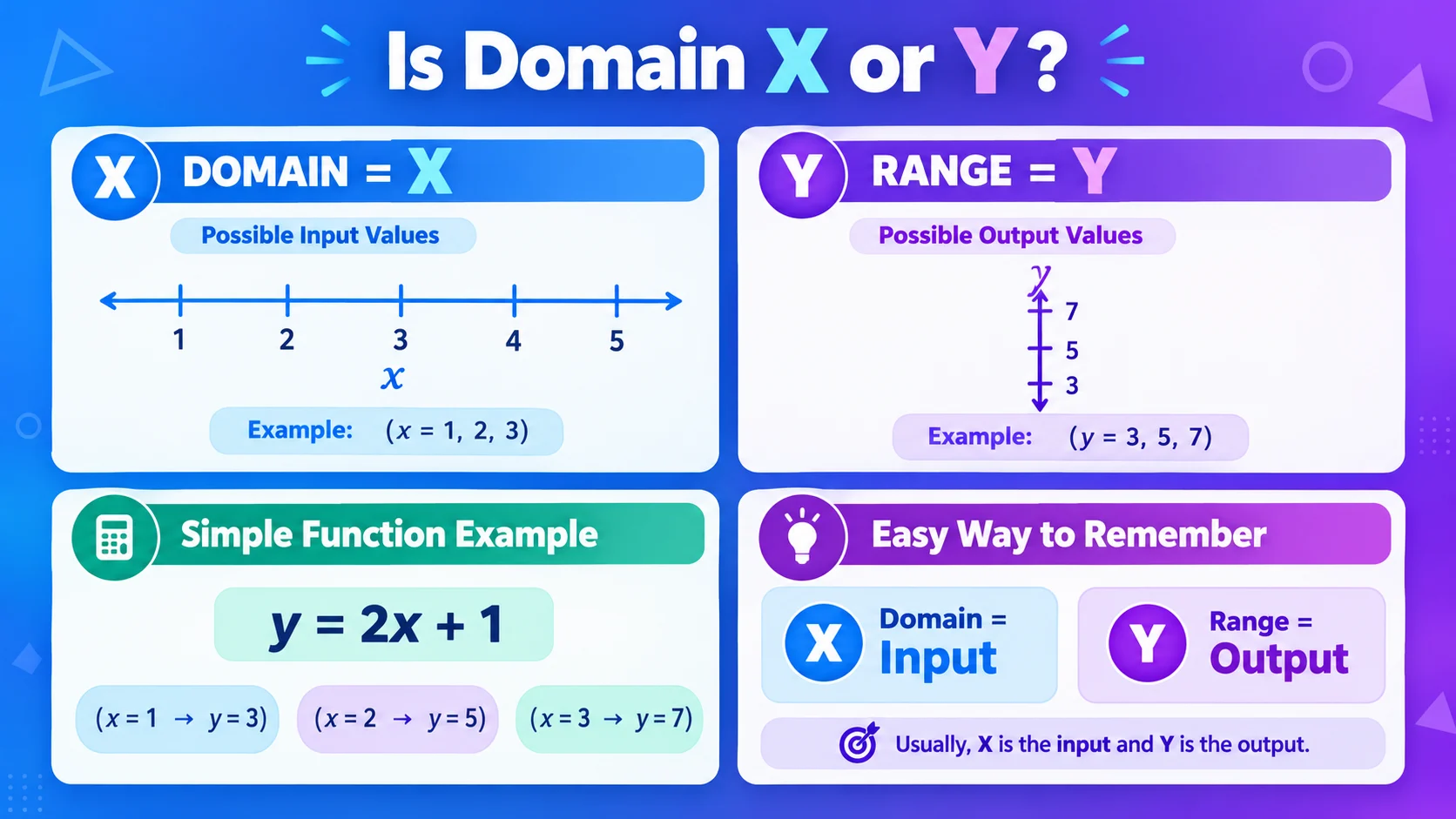
Is domain X or Y? In most algebra problems, the domain is the set of x-values, while the range is the set of y-values. The domain represents the possible inputs of a function, whereas the range represents the outputs the function can produce.
For example, in the equation (y=2x+1), you choose an (x)-value and use the equation to calculate the matching (y)-value. Therefore, (x) usually represents the input, and (y) represents the output.
However, this rule describes the most common setup, not every possible situation. The symbols can change depending on how a function is defined. To identify the domain correctly, focus on the inputs a function accepts rather than relying only on the letters.
Is Domain X or Y?
| Math Term | Usually Represents | Meaning |
|---|---|---|
| Domain | (x)-values | Possible inputs |
| Range | (y)-values | Possible outputs |
| Input | (x) | The value you choose |
| Output | (y) | The value calculated |
| Function | (y=f(x)) | A rule connecting inputs and outputs |
Easy way to remember: Domain = input = usually (x). Range = output = usually (y).
What Is the Domain in Math?
The domain is the set of all input values a function can accept. In a typical algebra equation, these values appear as (x).
For example, consider:
[
y=x+4
]
You can substitute different numbers for (x). Each allowed input produces a corresponding output.
- If (x=1), then (y=5).
- If (x=2), then (y=6).
- If (x=3), then (y=7).
In this example, the selected domain is ({1,2,3}). If the function has no restrictions and allows every real number, its domain is all real numbers.
However, some functions exclude certain inputs. For instance, division by zero is undefined. Therefore, you must check the function’s rules before deciding which values belong to the domain.
What Is the Range in Math?
The range is the set of output values a function produces. In the standard equation (y=f(x)), these outputs are usually represented by (y).
Consider the same equation:
[
y=x+4
]
Using the inputs above gives the outputs (5), (6), and (7). Consequently, the range for those selected inputs is ({5,6,7}).
The complete range depends on the domain. If every real number is allowed for (x), the equation (y=x+4) can produce every real number.
By contrast, consider this function:
[
y=x^2
]
Squaring a real number never produces a negative result. Therefore, the range includes zero and every positive real number, but no negative numbers.
Domain vs. Range: What Is the Difference?
Domain and range describe two different parts of a function. Although they work together, each answers a separate question.
| Feature | Domain | Range |
|---|---|---|
| Usually represents | (x)-values | (y)-values |
| Main role | Input | Output |
| Key question | What can go into the function? | What can come out? |
| How to find it | Identify allowed inputs | Identify possible outputs |
| Graph direction | Horizontal coverage | Vertical coverage |
For example, imagine a function that converts hours worked into money earned. The number of hours represents the input, while the earnings represent the output.
Therefore, the domain contains the allowed working hours, and the range contains the possible earnings.
How to Find the Domain and Range From Ordered Pairs
An ordered pair looks like ((x,y)). The first number represents the x-coordinate, while the second represents the y-coordinate.
Consider these points:
[
(1,3),\ (2,5),\ (4,9)
]
To find the domain, collect the first numbers:
[
\text{Domain}={1,2,4}
]
Next, collect the second numbers to find the range:
[
\text{Range}={3,5,9}
]
Notice that you list each distinct value only once.
For another example, consider:
[
(2,4),\ (3,4),\ (5,7)
]
The domain is ({2,3,5}), and the range is ({4,7}). Although two points share the output (4), you include it only once in the range.
How to Find Domain and Range on a Graph
A graph provides a visual way to identify inputs and outputs. However, you need to look in different directions for each one.
- Domain: Look from left to right to identify all x-values covered by the graph.
- Range: Look from bottom to top to identify all y-values covered by the graph.
For example, suppose a line segment begins at ((-2,1)) and ends at ((3,6)), with both endpoints included.
Its domain is:
[
[-2,3]
]
Its range is:
[
[1,6]
]
The square brackets mean the endpoints are included.
On the other hand, an open circle means the endpoint is excluded. An arrow usually indicates that the graph continues indefinitely in that direction.
Examples of Domain and Range
These examples show how the domain and range change depending on the function.
| Function | Domain | Range |
|---|---|---|
| (y=x+2) | All real numbers | All real numbers |
| (y=x^2) | All real numbers | (y\geq0) |
| (y=\frac{1}{x}) | (x\neq0) | (y\neq0) |
| (y=\sqrt{x}) | (x\geq0) | (y\geq0) |
| (y=2x+1), with (x\in{1,2,3}) | ({1,2,3}) | ({3,5,7}) |
These examples assume real-number inputs and outputs where applicable. As you can see, not every function accepts every real number.
For example, (y=\frac{1}{x}) excludes zero because division by zero is undefined. Similarly, (y=\sqrt{x}) requires nonnegative inputs when working with real numbers.
Is Domain Always X and Range Always Y?
No. In standard algebra, the domain usually contains (x)-values and the range usually contains (y)-values. However, domain and range describe roles, not specific letters.
For example, consider a function written as:
[
x=g(y)
]
Here, (y) is the input variable, and (x) is the output variable. Therefore, the domain contains the allowed (y)-values, while the range contains the resulting (x)-values.
Likewise, a function may use letters such as (t), (s), or (n). In those cases, identify the input and output from the function’s definition.
The main rule remains the same: the domain is the set of inputs, and the range is the set of outputs.
Common Mistakes When Identifying Domain and Range
Several mistakes can make these concepts confusing. Fortunately, a few simple checks can help.
Mistake 1: Mixing Up Inputs and Outputs
Remember that the domain tells you which values go into a function. The range tells you which values come out.
Mistake 2: Reading a Graph in the Wrong Direction
Read the domain horizontally and the range vertically. This approach makes graph questions much easier.
Mistake 3: Ignoring Restrictions
Some functions cannot accept every number. For example, denominators cannot equal zero, and square roots of negative numbers are not real numbers.
Mistake 4: Listing Repeated Values More Than Once
A domain or range is a set of distinct values. Therefore, remove duplicates when listing values from ordered pairs.
Mistake 5: Assuming the Letters Never Change
Although (x) and (y) are common, other variables can serve as inputs and outputs. Always examine the function’s definition first.
Frequently Asked Questions
Is domain X or Y?
In standard algebra, the domain is usually the set of (x)-values, while the range is the set of (y)-values. However, the domain always represents inputs, regardless of which variable appears in the equation.
Is domain the input or output?
The domain represents the input values a function accepts. In a typical equation such as (y=f(x)), the inputs are (x)-values. The outputs belong to the range and are usually represented by (y).
Is range X or Y?
In standard algebra, the range usually consists of the (y)-values a function produces. These are the outputs associated with allowed inputs. However, different variables may represent the outputs in other function definitions.
How do you find the domain from a graph?
To find the domain, examine the graph from left to right. Identify every x-coordinate covered by the graph, including or excluding endpoints according to the symbols shown. Arrows indicate that the graph continues.
How do you find the range from a graph?
To find the range, examine the graph from bottom to top. Identify every y-coordinate the graph reaches. Pay attention to open circles, closed circles, and arrows because they determine which values are included.
Can domain and range contain the same numbers?
Yes. Some functions have identical domain and range. For example, (y=x) has all real numbers as both its domain and range when no restrictions apply.
Can a domain contain zero?
Yes, unless the function’s rules exclude it. For example, (y=x+2) accepts zero, but (y=\frac{1}{x}) does not because division by zero is undefined.
What is the easiest way to remember domain and range?
Think of a function as a machine. The domain contains the numbers you put into the machine, while the range contains the numbers that come out. In standard algebra, inputs are usually (x) and outputs are (y).
Conclusion
Remember this simple rule: domain is usually X, and range is usually Y. The domain contains the inputs a function accepts, while the range contains the outputs it produces. For example, in (y=2x+1), (x) is the input and (y) is the output. However, other functions may use different variable names, so focus on each variable’s role. When reading a graph, find the domain horizontally and the range vertically. Also, check for restrictions such as division by zero. With these basics, you can identify domain and range more confidently.