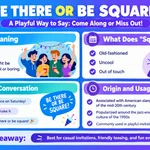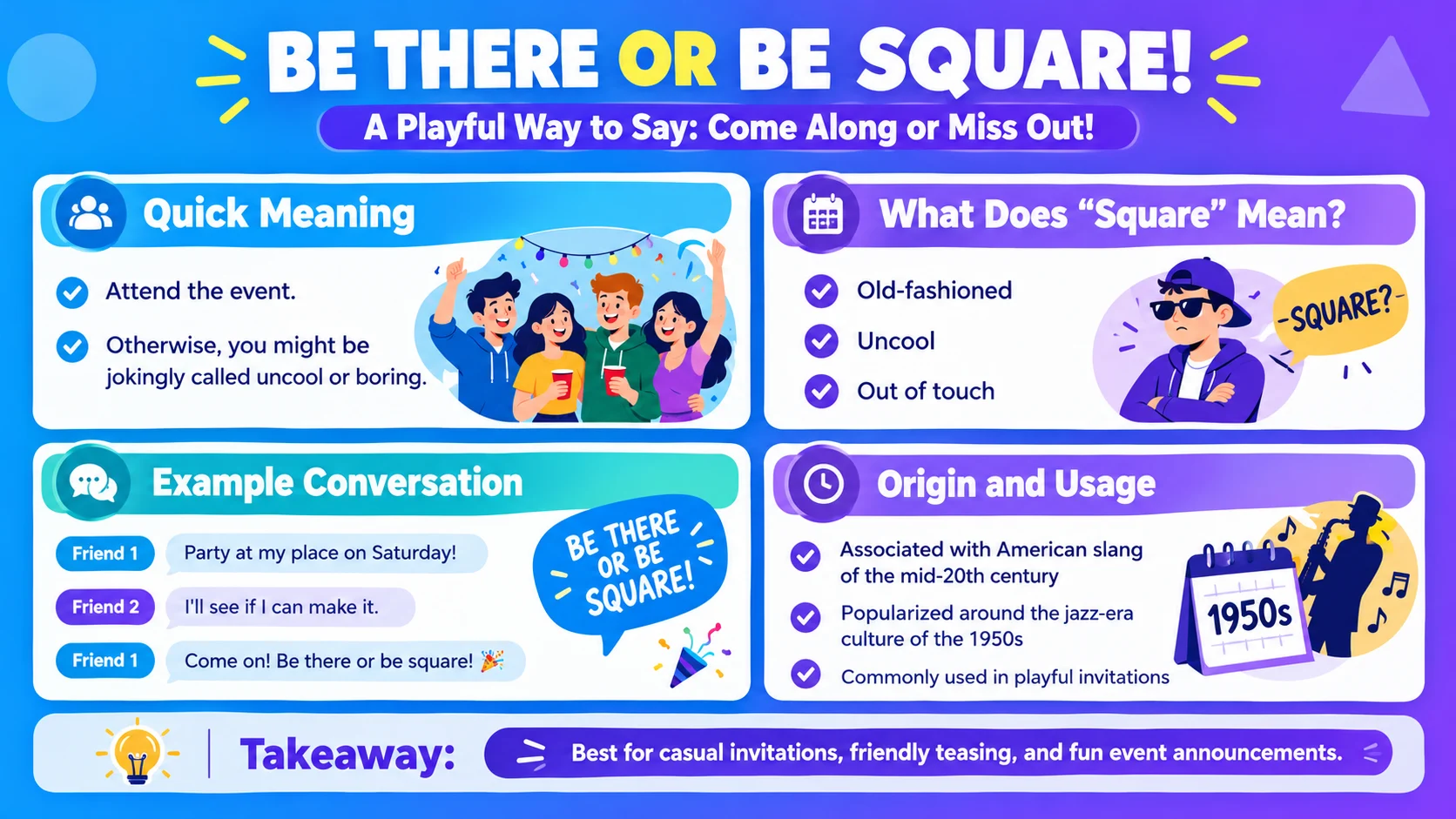
“Be there or be square” is a playful English expression that encourages someone to attend an event, party, or activity. It jokingly suggests that anyone who misses out is boring, uncool, or out of touch. People often use this phrase when inviting friends to social gatherings, celebrations, concerts, and other exciting events.
For example, someone might text, “We’re having a party on Saturday. Be there or be square!” The message is a fun way to encourage friends to show up. Although the phrase became popular in American slang decades ago, people still use it today, especially when they want an invitation to sound energetic, humorous, and memorable.
What Does Be There or Be Square Mean?
“Be there or be square” means you should attend an event or risk being jokingly considered uncool or boring. It is an informal, humorous expression that people use to encourage friends to join parties, gatherings, and other activities.
| Phrase | Meaning | Example |
|---|---|---|
| Be there or be square | Come along or be considered uncool | “The concert is Friday. Be there or be square!” |
| Be there | Attend the event | “Be there at 7 p.m.” |
| Square | Slang for boring or old-fashioned | “Don’t be such a square!” |
What Does Be There or Be Square Mean?
The phrase “be there or be square” is a humorous way to tell someone not to miss an event. It suggests that attending is the fun, popular, or exciting choice.
In this expression, the word “square” does not refer to a geometric shape. Instead, it describes someone who seems old-fashioned, conventional, or not particularly cool.
For example, imagine your friend invites you to a birthday party and says, “Everyone’s coming, so be there or be square!” Your friend probably isn’t trying to insult you. Rather, they are playfully encouraging you to join the fun.
The phrase can also appear in invitations to concerts, school reunions, game nights, festivals, and online events. In each case, the basic message remains the same: come along so you don’t miss out.
Where Did Be There or Be Square Come From?
The expression is associated with American slang from the middle of the 20th century, particularly the jazz culture of the 1940s and 1950s.
During that period, the word “square” became slang for someone considered conventional, uncool, or out of touch with current cultural trends. Jazz musicians and other young people used the term to contrast traditional attitudes with more adventurous styles and lifestyles.
The phrase “be there or be square” built on that meaning. Its rhyme made it catchy and easy to remember, helping it spread through casual speech and popular culture.
However, the precise first use of the complete expression is uncertain. The phrase is commonly associated with the 1950s, although related uses of “square” appeared earlier.
Over time, the expression became less of a serious judgment and more of a lighthearted invitation. Today, people often use it for fun, nostalgia, or a playful reminder to attend an event.
How to Use Be There or Be Square
You can use “be there or be square” when inviting someone to an informal event or encouraging a group to participate.
1. Inviting Friends to a Party
Use the phrase when you want friends to join a celebration.
Example:
“I’m hosting a birthday party this Saturday. Be there or be square!”
The expression makes the invitation sound lively and playful.
2. Promoting a Concert or Event
The phrase can also add excitement to an event announcement.
Example:
“Our favorite band is playing downtown tonight. Be there or be square!”
Here, the speaker suggests that the event is too exciting to miss.
3. Encouraging People to Join an Activity
You can use it for game nights, movie nights, group outings, or other shared activities.
Example:
“We’re playing basketball after school tomorrow. Be there or be square!”
In this situation, the phrase encourages participation without sounding too serious.
4. Posting on Social Media
The expression works well in casual posts, captions, and group messages.
Example:
“Movie night starts at 8! Bring your snacks and be there or be square 🎬”
Because the phrase is familiar and catchy, it can make an announcement feel more energetic.
Be There or Be Square: Examples in Everyday Conversations
These examples show how the expression works in different situations.
Example 1: A Birthday Party
Alex: “Are you coming to my birthday party?”
Jordan: “Maybe! I still need to check my schedule.”
Alex: “Come on, it’s going to be amazing. Be there or be square!”
Here, Alex uses the phrase to encourage Jordan to attend.
Example 2: A Weekend Concert
Mia: “We’re going to see a live band on Friday.”
Sam: “That sounds fun. Who’s playing?”
Mia: “Our favorite band! Be there or be square.”
The phrase adds excitement and makes the invitation feel friendly.
Example 3: A School Reunion
Taylor: “Have you heard about the school reunion?”
Chris: “Yes, but I’m not sure I can make it.”
Taylor: “You have to come. Be there or be square!”
In this conversation, the speaker jokingly encourages an old friend to attend.
Example 4: A Group Game Night
Riley: “We’re having a board game night at my place.”
Morgan: “What time does it start?”
Riley: “Seven o’clock. Be there or be square!”
The expression makes an ordinary invitation more playful.
Example 5: A Social Media Post
Post: “Summer festival this Saturday! Music, food, and games all day. Be there or be square!”
This example uses the phrase to attract attention and encourage people to participate.
Is Be There or Be Square Rude?
Generally, “be there or be square” is playful rather than rude. Friends often use it to create excitement or tease each other about missing an event.
However, the tone depends on the relationship and situation.
When close friends use the phrase, it usually sounds lighthearted. For example, “Come to movie night—be there or be square!” is a friendly invitation.
On the other hand, the phrase can feel pushy if someone uses it to pressure another person who has already declined. It may also sound inappropriate in serious or professional situations.
Therefore, consider the audience before using it. If you want to invite someone without teasing them, a simple “I hope you can make it” works just as well.
What Does Square Mean in Slang?
In slang, “square” can describe someone who seems conventional, old-fashioned, boring, or unfamiliar with current trends.
For example:
- “Don’t be such a square!”
- “He thinks staying home every weekend is exciting, but his friends call him a square.”
- “My parents thought our music was strange, but we thought they were square.”
The word has a long history in American informal language. In mid-20th-century jazz culture, it often described someone who was not considered modern, adventurous, or in tune with the scene.
Today, the term can sound dated or deliberately retro. Nevertheless, people still understand it in familiar expressions such as “be there or be square.”
Similar Expressions to Be There or Be Square
Several phrases communicate a similar message. However, each has a slightly different tone.
| Expression | Meaning | Tone |
|---|---|---|
| Don’t miss out! | Attend so you don’t miss the experience | Friendly |
| Come through! | Show up or join the group | Casual |
| You better be there! | Strongly encourage attendance | Playful or firm |
| See you there! | Express an expectation of meeting | Friendly |
| Everyone’s going! | Suggest that an event will be popular | Persuasive |
| Don’t be a stranger! | Encourage someone to visit or stay in touch | Warm |
| Be there or be square! | Attend or be jokingly called uncool | Humorous |
For example, “Don’t miss out!” is more neutral and works in many situations. By contrast, “be there or be square” has a distinctive rhyme and a more teasing, old-school feel.
Is Be There or Be Square Still Used Today?
Yes, people still use the expression, although it can sound nostalgic or deliberately retro.
You might encounter it in birthday invitations, event flyers, social media captions, school activities, or casual conversations. It is particularly useful when someone wants to make an invitation memorable.
For instance, a friend might write, “Game night at my place on Friday. Be there or be square!” The phrase gives the message a playful tone.
Meanwhile, younger speakers may choose more current expressions such as “pull up,” “come through,” or “don’t miss out.” Even so, “be there or be square” remains recognizable and can be used for humorous effect.
Common Mistakes When Using Be There or Be Square
Although the expression is easy to understand, a few mistakes can affect how it sounds.
Mistake 1: Taking the Phrase Literally
The phrase does not mean that someone will become a square shape if they skip an event. Instead, it uses “square” as slang for someone considered uncool or old-fashioned.
Mistake 2: Using It in Formal Communication
The expression is informal and playful. Therefore, it may not suit professional emails, official invitations, or serious business meetings.
For formal situations, try “We hope you can attend” or “Your presence would be appreciated.”
Mistake 3: Using It to Pressure Someone
The phrase works best when everyone understands the joke. However, repeating it after someone declines may make the invitation feel demanding.
Mistake 4: Assuming It Is an Insult Every Time
Although “square” can be negative, the complete expression often serves as friendly teasing. Context and tone determine how the message comes across.
Frequently Asked Questions
What does be there or be square mean?
“Be there or be square” is a playful expression encouraging someone to attend an event. It jokingly suggests that people who skip the occasion are boring, old-fashioned, or uncool.
Where did be there or be square originate?
The phrase is associated with American slang from the mid-20th century, especially the jazz culture of the 1940s and 1950s. The exact first use of the complete expression remains uncertain.
Is be there or be square an idiom?
Yes. It is an informal idiomatic expression because its intended meaning goes beyond the literal words. Instead of referring to a geometric shape, “square” means someone considered uncool or old-fashioned.
Is be there or be square rude?
Usually, no. Friends commonly use it as a joke or playful invitation. However, it can sound pushy if someone uses it to pressure a person who has already declined.
Can I use be there or be square in a text?
Yes. The expression works well in casual text messages, group chats, and social media invitations. For example, “Party starts at 8! Be there or be square 🎉” sounds friendly and energetic.
What does square mean in slang?
In slang, “square” describes someone considered conventional, boring, old-fashioned, or out of touch with current trends. The word appears in the expression “be there or be square.”
What is another way to say be there or be square?
You can say “don’t miss out,” “come through,” “you better be there,” or “hope you can make it.” These alternatives encourage attendance without necessarily teasing the person.
Is be there or be square still popular?
The phrase remains recognizable in English, although it can sound nostalgic or retro. People still use it in casual invitations, event announcements, and social media posts to encourage others to attend.
Conclusion
“Be there or be square” is a catchy way to encourage someone to attend an event. The phrase combines a friendly invitation with a playful warning that anyone who misses out might seem uncool or old-fashioned. Rooted in American slang and associated with mid-20th-century jazz culture, it remains recognizable today. You can use it when inviting friends to parties, concerts, game nights, or social gatherings. However, remember that the expression works best in informal situations where everyone understands the joke. When you want a gentler invitation, “I hope you can make it” is a great alternative.