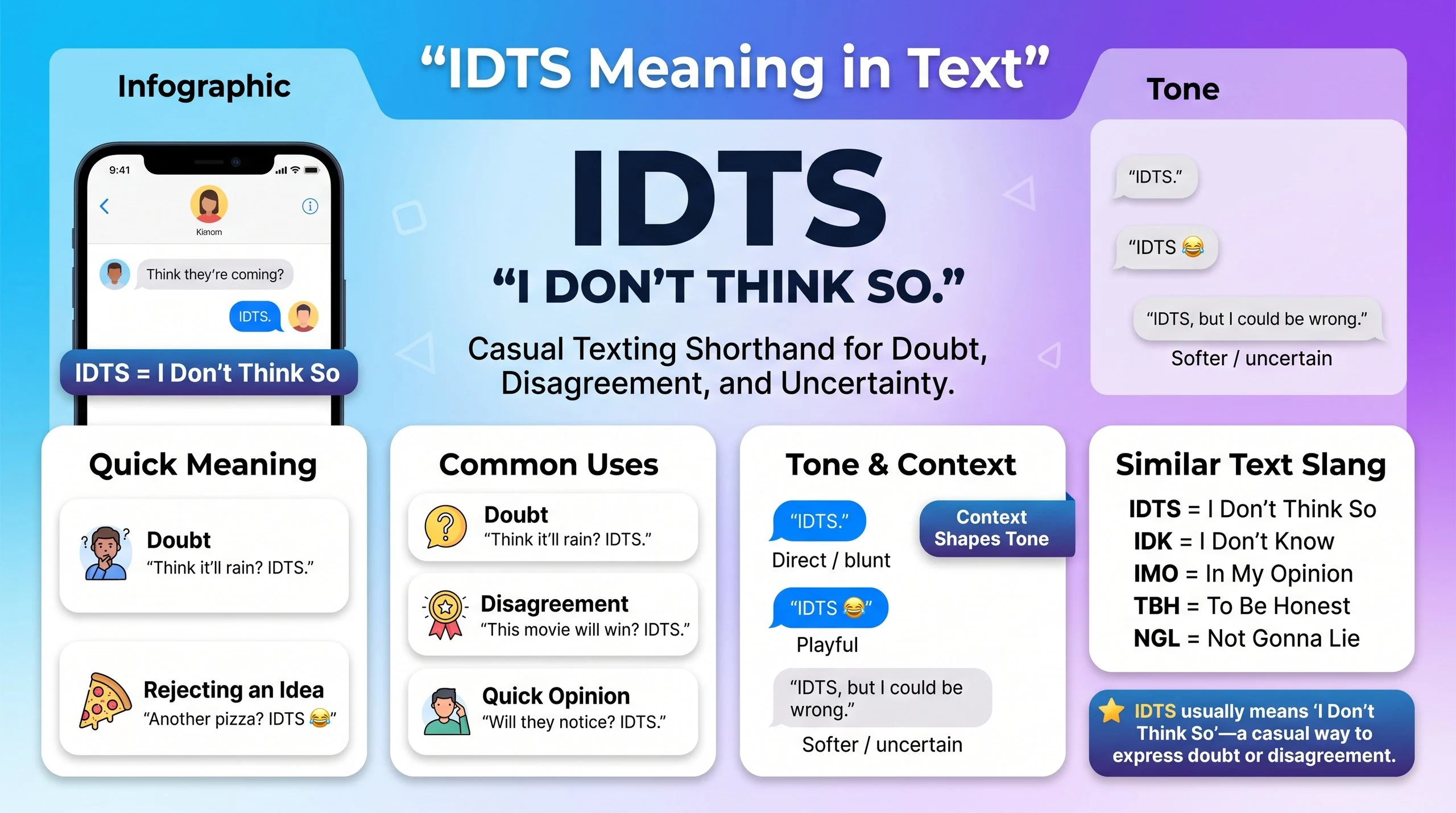
IDTS usually means “I Don’t Think So” in text. People use it to express disagreement, doubt, or uncertainty about something. Depending on context, IDTS can sound casual, skeptical, playful, or slightly dismissive.
If someone sends you “IDTS,” you may wonder what this short abbreviation means. In texting, IDTS usually means “I Don’t Think So.” It is a casual way to disagree with a statement, reject an idea, or say that something seems unlikely.
For example, if someone asks, “Do you think Jake is coming?” you could reply, “IDTS.” This means, “I don’t think so.”
However, the tone can change depending on the conversation. A friendly exchange may make IDTS sound casual or playful. On the other hand, a short reply with no explanation can sometimes sound blunt or dismissive.
Therefore, context matters. This guide explains the meaning of IDTS, how people use it on Snapchat, TikTok, Instagram, and in text messages, plus its tone, examples, similar slang, and common mistakes.
What Does IDTS Mean in Text?
| Term | Meaning | Typical Use |
|---|---|---|
| IDTS | I Don’t Think So | Disagreement or doubt |
| IDK | I Don’t Know | Uncertainty or lack of knowledge |
| IMO | In My Opinion | Giving an opinion |
| NGL | Not Gonna Lie | Honest statement |
| FR | For Real | Agreement or emphasis |
Generally, IDTS means “I Don’t Think So” and works as a quick response when someone disagrees or doubts something.
What Does IDTS Mean in Text?
IDTS means “I Don’t Think So.”
It is a casual texting abbreviation that expresses a negative opinion or doubt.
For example:
“Do you think she’ll come tonight?”
“IDTS.”
The response means:
“I don’t think so.”
Someone may use IDTS because they disagree, expect something not to happen, or simply have doubts.
Unlike a strong statement such as “No,” IDTS can sometimes sound softer because it presents the response as an opinion rather than absolute certainty.
How Is IDTS Used in Texting?
IDTS can work in several common situations.
Expressing Disagreement
Someone might use IDTS when they do not agree with another person’s opinion.
A: “This movie is going to win an award.”
B: “IDTS.”
Here, IDTS means “I don’t think so.”
Showing Doubt
IDTS can also communicate uncertainty.
A: “Do you think we’ll finish before 5?”
B: “IDTS.”
The sender believes finishing before 5 is unlikely.
Rejecting a Suggestion
Someone can use IDTS when they do not agree with a proposed idea.
A: “Should we order another pizza?”
B: “IDTS 😂”
This can mean the person does not think another pizza is necessary.
Giving a Quick Opinion
Sometimes IDTS simply provides a short personal judgment.
“Will they notice?”
“IDTS.”
The sender is saying they do not believe the other person will notice.
IDTS Meaning on Snapchat
On Snapchat, IDTS usually means “I Don’t Think So.”
Snapchat conversations often use short abbreviations because users want to communicate quickly.
For example:
“You think he’ll snap back?”
“IDTS.”
The sender probably means they do not think he will respond.
Similarly:
“Are we going out tonight?”
“IDTS, everyone’s tired.”
Here, IDTS introduces an opinion based on the situation.
IDTS Meaning on TikTok
On TikTok, IDTS can appear in comments, direct messages, or conversations about videos.
For example:
“Do you think this trend will last?”
“IDTS.”
The person doubts that the trend will remain popular.
In comments, IDTS can also respond to someone’s prediction or opinion.
Because TikTok conversations are informal, the abbreviation usually has a casual tone.
IDTS Meaning on Instagram
On Instagram, IDTS may appear in DMs, comments, or group chats.
For example:
“Think she’ll post about it?”
“IDTS.”
The sender means “I don’t think so.”
Likewise, someone might respond:
“IDTS tbh.”
This adds emphasis and means something like “Honestly, I don’t think so.”
IDTS Meaning From a Girl
If a girl sends you IDTS, the basic meaning is still “I Don’t Think So.”
For example:
“Do you think he’ll text you?”
“IDTS.”
She is expressing doubt.
However, the abbreviation itself does not reveal romantic interest, dislike, or any special intention. The surrounding conversation matters more.
If she says:
“IDTS 😂”
the laughing emoji may make the response feel playful.
In contrast:
“IDTS.”
may sound more direct or serious.
IDTS Meaning From a Guy
If a guy texts IDTS, it generally means “I Don’t Think So.”
For example:
“Do you think we’re getting out early?”
“IDTS.”
He is saying he does not expect that to happen.
Likewise, a message such as “IDTS bro” usually has a casual and friendly tone.
The sender’s gender does not change the standard meaning of IDTS.
Is IDTS Flirty?
IDTS is not inherently flirty.
It is primarily an abbreviation for expressing doubt or disagreement.
For example:
“You think she likes you?”
“IDTS.”
That is simply an opinion.
However, context can add a playful or teasing tone. For instance:
“You think you can beat me? IDTS 😉”
Here, the wink makes the message more playful. Still, the abbreviation itself is not romantic or flirty.
Is IDTS Rude?
IDTS is not automatically rude.
It can be a normal, casual way to disagree. However, a one-word response can sometimes feel blunt.
Compare these messages:
“IDTS.”
and:
“IDTS, but I could be wrong.”
The second version sounds softer because it acknowledges uncertainty.
Therefore, tone depends on the conversation, punctuation, emojis, and relationship between the people.
IDTS Examples in Real Conversations
Example 1: Plans
A: “Do you think they’re coming?”
B: “IDTS.”
Meaning: I don’t think so.
Example 2: Weather
A: “Think it’ll rain tonight?”
B: “IDTS. The sky looks clear.”
Meaning: I don’t think it will rain.
Example 3: School or Work
A: “Are we getting off early?”
B: “IDTS 😭”
Meaning: I don’t think so.
Example 4: Dating
A: “Do you think she likes him?”
B: “IDTS.”
Meaning: I don’t think she does.
Example 5: Playful
A: “Think you can beat me?”
B: “IDTS 😂”
Here, IDTS can sound teasing rather than serious.
IDTS vs. Similar Texting Abbreviations
| Abbreviation | Meaning | Difference |
|---|---|---|
| IDTS | I Don’t Think So | Doubt or disagreement |
| IDK | I Don’t Know | Lack of knowledge |
| IDC | I Don’t Care | Lack of concern or preference |
| IMO | In My Opinion | Introduces an opinion |
| TBH | To Be Honest | Introduces an honest statement |
| NGL | Not Gonna Lie | Signals an honest opinion |
| FR | For Real | Agreement or emphasis |
| IKR | I Know, Right? | Strong agreement |
For example, IDK means the person does not know the answer. IDTS, however, means the person has an opinion that something is unlikely or incorrect.
Common Phrases With IDTS
People may combine IDTS with other texting slang.
“IDTS tbh”
Means:
“I don’t think so, to be honest.”
“IDTS lol”
Adds a light or humorous tone.
“IDTS 😂”
Usually sounds playful or amused.
“IDTS bro”
Adds a casual, friendly tone.
“IDTS rn”
Means:
“I don’t think so right now.”
The exact meaning can change slightly depending on the rest of the sentence.
Common Mistakes When Understanding IDTS
Mistake 1: Confusing IDTS With IDK
IDK means “I don’t know,” while IDTS means “I don’t think so.”
They express different ideas.
Mistake 2: Assuming IDTS Means a Definite “No”
IDTS usually expresses an opinion or expectation.
Someone saying IDTS may still be uncertain.
Mistake 3: Assuming It Is Always Negative
IDTS can disagree with a statement, but it does not necessarily express anger or negativity.
Mistake 4: Reading Flirting Into the Abbreviation
IDTS itself is not romantic or suggestive.
The broader conversation determines the tone.
Mistake 5: Ignoring Context
A message like “IDTS 😂” can sound very different from “IDTS.”
Emojis, punctuation, and surrounding messages all matter.
How to Respond to IDTS
Your response depends on what the person is disagreeing with.
If you agree, you could say:
“Yeah, same.”
Or:
“I don’t think so either.”
If you disagree:
“Really? I think they will.”
If you want more information:
“Why not?”
You can also ask:
“What makes you think that?”
Therefore, the best response depends on whether you want to agree, challenge the opinion, or continue the conversation.
When Should You Use IDTS?
IDTS works well in casual conversations with friends, family, classmates, or people who understand texting slang.
You can use it when:
- You doubt something will happen.
- You disagree with an opinion.
- You want to reject a suggestion casually.
- You think something is unlikely.
- You want to give a quick negative opinion.
However, avoid IDTS in formal emails, academic writing, or professional documents. In those settings, write “I don’t think so” or explain your position more clearly.
Other Meanings of IDTS
In everyday texting, “I Don’t Think So” is the main meaning of IDTS.
However, abbreviations can have specialized meanings in specific industries, organizations, technical systems, or communities.
Therefore, if IDTS appears in a professional or technical document rather than a casual conversation, do not automatically interpret it as texting slang. The surrounding subject should determine the meaning.
Frequently Asked Questions
1. What does IDTS mean in text?
IDTS usually means “I Don’t Think So.” It is a casual texting abbreviation used to express doubt, disagreement, or the belief that something is unlikely to happen.
2. What does IDTS mean in slang?
In casual slang, IDTS means “I Don’t Think So.” People use it as a quick response when they disagree with an idea or believe something probably will not happen.
3. Is IDTS the same as IDK?
No. IDTS means “I Don’t Think So,” while IDK means “I Don’t Know.” IDTS expresses an opinion or expectation, whereas IDK shows that the person does not know the answer.
4. What does IDTS mean on Snapchat?
On Snapchat, IDTS generally means “I Don’t Think So.” It can be used to disagree, express doubt, or respond quickly to someone’s question or prediction.
5. What does IDTS mean from a girl?
If a girl sends IDTS, she is usually saying “I Don’t Think So.” The abbreviation itself does not indicate flirting or romantic interest. The surrounding conversation provides more context.
6. What does IDTS mean from a guy?
If a guy sends IDTS, it generally means “I Don’t Think So.” His gender does not change the meaning. His punctuation, emojis, and surrounding messages may affect the tone.
7. Is IDTS rude?
IDTS is not inherently rude. However, a short reply such as “IDTS.” can sound blunt in some situations. A longer response can make the disagreement feel more friendly or respectful.
8. Is IDTS flirty?
IDTS is not normally flirty. It simply means “I Don’t Think So.” A playful conversation may give it a teasing tone, but the abbreviation itself does not communicate romantic interest.
Conclusion
Overall, IDTS means “I Don’t Think So” in text. People use it to express doubt, disagreement, uncertainty, or the belief that something is unlikely. It works well in casual conversations on messaging apps and social media. However, its tone can change based on punctuation, emojis, and the surrounding conversation. For example, “IDTS 😂” may sound playful, while “IDTS.” can feel more direct. Also, IDTS is different from IDK because it expresses an opinion rather than a lack of knowledge. Therefore, when someone sends IDTS, read the full conversation before interpreting their tone or intention.