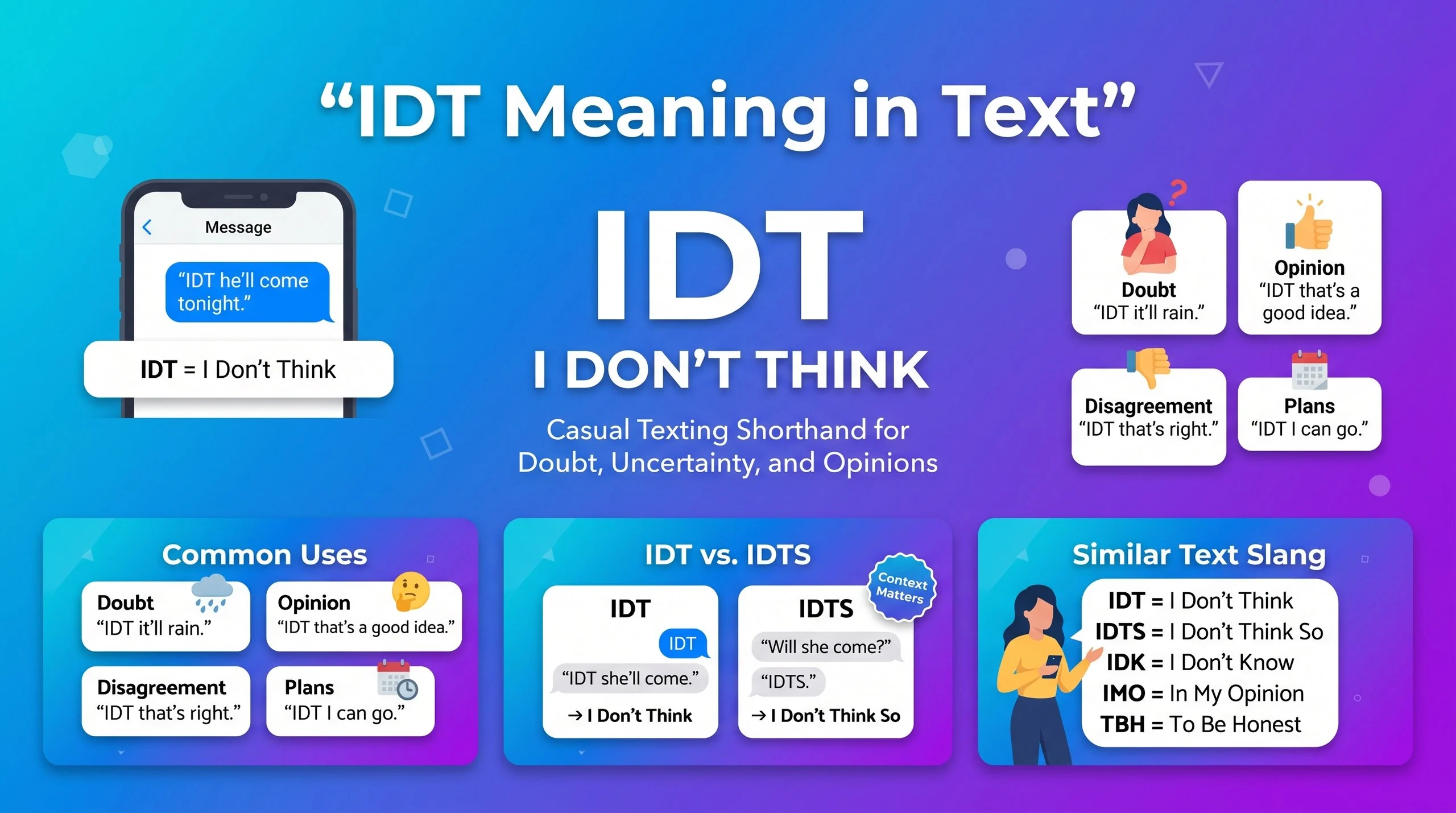
IDT usually means “I Don’t Think” in text. It is a casual abbreviation used to express doubt, uncertainty, or an opinion. In some contexts, IDT can also mean something else, so the surrounding conversation matters.
If someone texts “IDT,” you may wonder what this short abbreviation means. In casual texting, IDT usually means “I Don’t Think.” People use it when they want to express doubt, uncertainty, or a personal opinion without writing the full phrase.
For example, someone might say, “IDT that’s going to happen.” This means, “I don’t think that’s going to happen.”
However, IDT is not always used as a standalone response. It often appears before another statement, such as “IDT he knows” or “IDT we should go.” Therefore, the words that follow IDT can help clarify the intended meaning.
This guide explains what IDT means in texting, how people use it on social media, what it means from a girl or guy, whether it sounds rude or flirty, and how to respond.
What Does IDT Mean in Text?
| Term | Meaning | Typical Use |
|---|---|---|
| IDT | I Don’t Think | Expressing doubt or an opinion |
| IDTS | I Don’t Think So | Giving a negative answer |
| IDK | I Don’t Know | Showing uncertainty or lack of knowledge |
| IMO | In My Opinion | Introducing an opinion |
| TBH | To Be Honest | Introducing an honest statement |
Generally, IDT means “I Don’t Think” when used in casual texting.
What Does IDT Mean in Text?
IDT usually means “I Don’t Think.”
It is a shortened form of the phrase people use to express an opinion, doubt, or uncertainty.
For example:
“IDT he’s coming tonight.”
This means:
“I don’t think he’s coming tonight.”
Similarly:
“IDT we should do that.”
means:
“I don’t think we should do that.”
Unlike IDTS, which can stand alone as “I Don’t Think So,” IDT often connects directly to the rest of a sentence.
How Is IDT Used in Texting?
IDT can appear in several situations.
Expressing Doubt
Someone may use IDT when they believe something is unlikely.
“IDT it will rain today.”
The sender thinks rain is unlikely.
Giving an Opinion
IDT can introduce a personal judgment.
“IDT that movie was very good.”
Here, the person is expressing their opinion.
Disagreeing Politely
IDT can make disagreement sound less absolute.
“IDT that’s the right answer.”
This sounds softer than simply saying:
“That’s wrong.”
Talking About Plans
People often use IDT when discussing future events.
“IDT I can go tonight.”
This means:
“I don’t think I can go tonight.”
IDT Meaning on Snapchat
On Snapchat, IDT generally means “I Don’t Think.”
Because Snapchat conversations are usually casual, people often shorten common phrases.
For example:
“IDT he saw my snap.”
means:
“I don’t think he saw my snap.”
Another example is:
“IDT we’re going anymore.”
This means the sender does not believe they are going anymore.
The exact tone depends on the rest of the conversation.
IDT Meaning on TikTok
On TikTok, IDT can appear in comments, direct messages, or private conversations.
For example:
“IDT this trend is going to last.”
The person is expressing doubt about the trend.
Likewise:
“IDT that’s what they meant.”
shows uncertainty about someone’s intention.
Since TikTok communication is informal, IDT usually has a casual tone.
IDT Meaning on Instagram
On Instagram, IDT may appear in DMs, group chats, comments, or replies.
For example:
“IDT she’ll post today.”
means:
“I don’t think she’ll post today.”
Someone might also write:
“IDT that’s true tbh.”
This means:
“I don’t think that’s true, to be honest.”
Therefore, IDT often works as a quick way to introduce an opinion.
IDT Meaning From a Girl
If a girl sends IDT, she is usually expressing doubt or an opinion.
For example:
“IDT he’s going to text you.”
means:
“I don’t think he’s going to text you.”
However, IDT itself does not indicate romantic interest, rejection, or flirting.
The rest of the conversation matters more. For instance, “IDT 😂” may sound playful, while “IDT.” may feel more direct.
IDT Meaning From a Guy
If a guy sends IDT, it generally means “I Don’t Think.”
For example:
“IDT we have enough time.”
means:
“I don’t think we have enough time.”
Likewise:
“IDT she knows.”
means:
“I don’t think she knows.”
The sender’s gender does not change the standard meaning of IDT.
Is IDT Flirty?
IDT is not inherently flirty.
It is primarily used to express an opinion or doubt.
For example:
“IDT you’re ready 😂”
could simply be playful teasing.
However, a romantic or playful conversation can give the message a different tone.
For example:
“IDT you can handle a date with me 😉”
could sound flirtatious because of the surrounding wording and emoji. The abbreviation itself is not flirty.
Is IDT Rude?
IDT is not automatically rude.
It can actually make disagreement sound less direct.
Compare:
“That won’t work.”
with:
“IDT that will work.”
The second version presents the statement as an opinion.
Still, a very short message can sometimes feel blunt. Therefore, tone depends on punctuation, context, and the relationship between the people.
IDT Examples in Real Conversations
Example 1: Plans
A: “Are you coming tonight?”
B: “IDT I can.”
Meaning: I don’t think I can.
Example 2: Weather
A: “Think it’ll rain?”
B: “IDT.”
Here, IDT may be used as a shortened response meaning “I don’t think so,” although IDTS is clearer for that standalone meaning.
Example 3: School
A: “Do you think the teacher will cancel class?”
B: “IDT she will.”
Meaning: I don’t think she will.
Example 4: Opinion
A: “Was that a good movie?”
B: “IDT it was that good.”
Meaning: I don’t think it was that good.
Example 5: Playful
A: “Think you can beat me?”
B: “IDT 😂”
Here, the response may sound teasing and lighthearted.
IDT vs. IDTS
These two abbreviations are closely related, but they are not exactly the same.
| Abbreviation | Meaning | Example |
|---|---|---|
| IDT | I Don’t Think | “IDT he’ll come.” |
| IDTS | I Don’t Think So | “Will he come?” → “IDTS.” |
IDT usually introduces or connects to the rest of a sentence.
IDTS can more naturally stand alone as a negative answer.
For example:
“Do you think he’ll come?”
“IDTS.”
But:
“IDT he’ll come.”
Both communicate doubt, but their sentence structures differ.
IDT vs. Similar Texting Abbreviations
| Abbreviation | Meaning | Main Difference |
|---|---|---|
| IDT | I Don’t Think | Expresses doubt or an opinion |
| IDTS | I Don’t Think So | Short negative response |
| IDK | I Don’t Know | Shows lack of knowledge |
| IDC | I Don’t Care | Shows lack of concern |
| IMO | In My Opinion | Introduces an opinion |
| TBH | To Be Honest | Signals honesty |
| NGL | Not Gonna Lie | Introduces an honest statement |
For example, IDK means the person does not know. IDT means the person has a belief or opinion about something.
Common Phrases With IDT
People often combine IDT with other texting expressions.
“IDT so”
This can mean “I don’t think so.”
“IDT tbh”
Means:
“I don’t think, to be honest.”
Usually, the phrase continues with more information.
“IDT lol”
The “lol” can make the message sound lighter or more playful.
“IDT 😂”
The laughing emoji may signal humor, teasing, or disbelief.
“IDT rn”
This can mean:
“I don’t think [so] right now.”
The exact interpretation depends on the surrounding words.
Common Mistakes When Understanding IDT
Mistake 1: Confusing IDT With IDTS
Although they are related, IDT means “I Don’t Think,” while IDTS means “I Don’t Think So.”
Mistake 2: Assuming IDT Always Means “I Don’t Think So”
In many sentences, IDT needs additional words.
For example:
“IDT she’s coming.”
The full meaning is “I don’t think she’s coming.”
Mistake 3: Confusing IDT With IDK
IDK means “I Don’t Know.”
IDT expresses a belief or opinion, while IDK indicates that the person lacks an answer.
Mistake 4: Assuming IDT Is Negative or Angry
IDT can simply express uncertainty.
It does not automatically show anger, dislike, or frustration.
Mistake 5: Reading Flirting Into IDT
IDT itself has no romantic meaning.
Always consider the full message and conversation.
How to Respond to IDT
Your response depends on what the person says after IDT.
- If you agree, you could reply:
“Yeah, I don’t think so either.”
- If you disagree, you could say:
“Really? I think it will happen.”
- If you want an explanation:
“Why do you think that?”
You can also ask:
“What makes you think so?”
Therefore, the best response depends on whether you agree, disagree, or want more information.
When Should You Use IDT?
IDT is suitable for casual conversations with friends, family, classmates, and other people who understand texting shorthand.
You can use it when:
- Expressing doubt
- Giving a personal opinion
- Disagreeing casually
- Discussing plans
- Predicting what might happen
- Saying that you probably cannot do something
For formal communication, however, it is better to write “I don’t think” in full.
Other Meanings of IDT
In casual texting, “I Don’t Think” is the most relevant meaning of IDT.
However, IDT can represent different terms in specialized fields, organizations, technical documents, or professional settings.
Therefore, if you encounter IDT outside a casual conversation, check the subject and surrounding terminology before assuming it means “I Don’t Think.”
Frequently Asked Questions
1. What does IDT mean in text?
IDT usually means “I Don’t Think.” It is a casual abbreviation used to express doubt, uncertainty, or an opinion. For example, “IDT he’ll come” means “I don’t think he’ll come.”
2. What does IDT mean in slang?
In texting slang, IDT generally means “I Don’t Think.” People use it to express a belief, doubt, or opinion without typing the complete phrase.
3. What is the difference between IDT and IDTS?
IDT means “I Don’t Think,” while IDTS means “I Don’t Think So.” IDT often appears within a sentence, whereas IDTS can work as a standalone response.
4. What does IDT mean on Snapchat?
On Snapchat, IDT usually means “I Don’t Think.” For example, “IDT he’s coming” means “I don’t think he’s coming.” It is a casual abbreviation used in quick conversations.
5. What does IDT mean from a girl?
If a girl sends IDT, she is usually expressing doubt or an opinion. The abbreviation does not automatically indicate flirting, rejection, or romantic interest. The surrounding conversation provides more context.
6. What does IDT mean from a guy?
If a guy sends IDT, it generally means “I Don’t Think.” His gender does not change the abbreviation’s standard meaning. Context and the rest of the message determine the tone.
7. Is IDT rude?
IDT is not inherently rude. It can make a disagreement sound like a personal opinion rather than an absolute statement. Still, a very short reply may feel blunt depending on the conversation.
8. Is IDT flirty?
IDT is not normally flirty. It simply expresses doubt or an opinion. A playful or romantic conversation can give the message a different tone, but IDT itself has no romantic meaning.
Conclusion
Overall, IDT usually means “I Don’t Think” in text. It is a casual abbreviation used to express doubt, uncertainty, disagreement, or a personal opinion. Unlike IDTS, which often works as a standalone “I Don’t Think So,” IDT commonly appears before the rest of a sentence. For example, “IDT she’ll come” means “I don’t think she’ll come.” The abbreviation is not inherently rude or flirty, although punctuation, emojis, and context can affect its tone. Therefore, when someone sends IDT, consider the complete message before interpreting their meaning. In formal communication, it is usually better to write “I don’t think” in full.

Andrew Morris is a writer at Meaninga.com who specializes in word meanings, slang, idioms and modern language trends. He creates clear, accurate and easy to understand content for everyday readers.