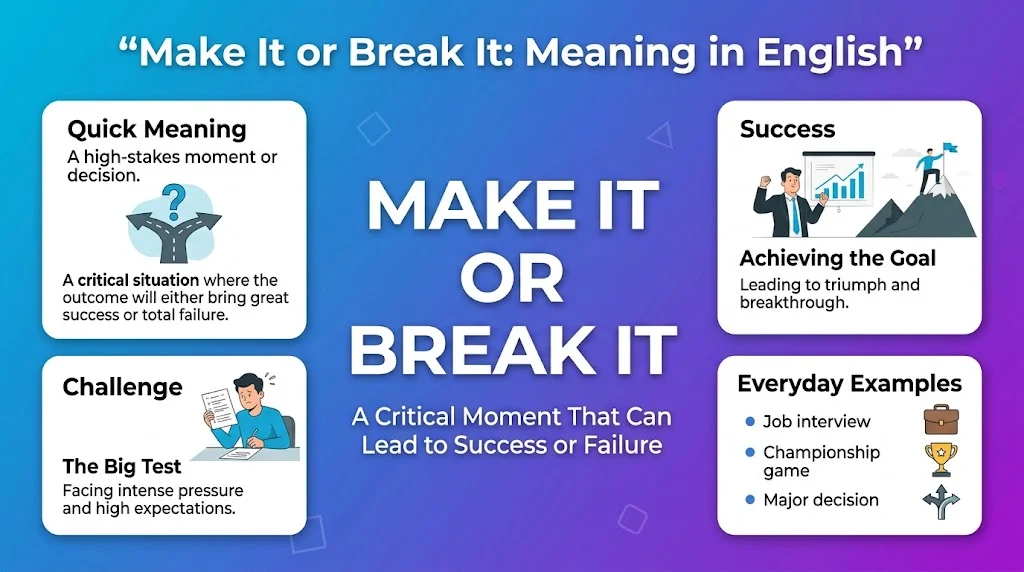
“Make it or break it” describes a situation that can determine success or failure. It often refers to a crucial moment, decision, or opportunity when the outcome could change everything.
Make it or break it is a common English expression used when someone faces an important challenge or a decisive moment. It describes a situation where the result could lead to success or failure, depending on what happens next. You might hear the phrase before a job interview, during a championship game, or while discussing a major business decision. In everyday conversation, people also use it to describe opportunities that could change their careers, relationships, or future plans. The expression often carries a sense of pressure because the stakes feel high. However, it does not always mean that everything depends on one event. Understanding its meaning, examples, and context can help you use the phrase naturally in speaking, texting, and writing.
What Does “Make It or Break It” Mean?
“Make it or break it” means that a situation could lead to success or failure. It is used when an important event, decision, or opportunity may have a major effect on the outcome.
For example:
- “Tomorrow’s interview could make it or break it for me.”
- “This final game will make it or break it for our team.”
- “The next product launch could make it or break it for the company.”
In each example, the outcome matters. A positive result could create an opportunity, while a negative result could cause a setback.
The phrase is often associated with pressure, determination, and uncertainty. Still, the exact meaning depends on the context.
How Is “Make It or Break It” Used?
People use this expression in several situations.
1. Work and Career
At work, “make it or break it” often describes an important interview, presentation, promotion, or business decision.
Example: “This presentation could make it or break it for my promotion.”
Meaning: The presentation may strongly influence whether the speaker gets promoted.
2. Sports and Competitions
Athletes and teams may use the phrase before an important match or competition.
Example: “It’s a make-it-or-break-it game for the team.”
Meaning: The game could determine whether the team advances, wins a title, or faces elimination.
3. Relationships
In relationships, the phrase can describe a conversation or decision that may affect the future of a partnership.
Example: “We need to talk honestly. This conversation could make it or break it for us.”
Meaning: The conversation may help repair the relationship or reveal problems that are difficult to resolve.
4. School and Education
Students might use the expression when talking about a final exam, scholarship interview, or important application.
Example: “This final exam feels like make-it-or-break-it time.”
Meaning: The result may have a significant impact on the student’s grade or academic plans.
5. Business and Entrepreneurship
Business owners may use the phrase when discussing a product launch, investment, or major contract.
Example: “The holiday season could make it or break it for this small business.”
Meaning: Sales during that period may strongly influence the business’s financial future.
Examples of “Make It or Break It” in Everyday Conversation
Here are natural examples of how people use the phrase.
Example 1: Before an interview
“Wish me luck. This interview could make it or break it.”
Example 2: During a competition
“We’ve trained all season for this. It’s make-it-or-break-it time.”
Example 3: Discussing a project
“If we deliver the project on time, we could secure the client. This deadline might make it or break it.”
Example 4: Talking about a business
“Our new product needs to perform well. This launch could make it or break it for us.”
Example 5: Discussing a relationship
“We need to figure out whether we’re willing to work through this. It could make it or break it.”
Example 6: Encouraging a friend
“You’ve prepared for months. Stay focused and give it your best.”
In the last example, the expression is implied rather than stated directly.
What Does “Make-It-or-Break-It Moment” Mean?
A make-it-or-break-it moment is a critical point when the outcome may significantly affect what happens next.
For example, a singer auditioning for a major competition may describe the audition as a make-it-or-break-it moment. A successful performance could open new doors, while a poor performance might end that particular opportunity.
The expression can also refer to a decision rather than a single event.
Example: “Choosing the right business partner was a make-it-or-break-it decision.”
Here, the choice could influence the long-term success of the business.
Is “Make It or Break It” Positive or Negative?
The phrase can sound positive, negative, or neutral depending on the situation.
- Positive: It can express ambition and excitement about a major opportunity.
- Negative: It can highlight the fear of failure or the consequences of a poor result.
- Neutral: It can simply describe an important turning point.
For example, “This is our chance to make it or break it” may sound motivating when a team feels ready for a challenge. However, the same phrase might communicate anxiety when someone feels unprepared.
Although the expression emphasizes high stakes, it does not guarantee that one event will determine someone’s entire future.
“Make It or Break It” vs. Similar Expressions
Several expressions communicate a similar idea, but their meanings are not always identical.
| Expression | Meaning | Example |
|---|---|---|
| Make it or break it | A situation could lead to success or failure | This deal could make it or break it. |
| Turning point | An event that changes the direction of a situation | Graduation was a turning point for her. |
| Now or never | The opportunity may not come again | It’s now or never. |
| Do or die | A situation feels extremely urgent or critical | It’s a do-or-die match. |
| Sink or swim | Someone must succeed or learn to cope without much help | The new job was sink or swim. |
| Deal-breaker | Something that makes an agreement or relationship unacceptable | Dishonesty is a deal-breaker for me. |
The main difference is that “make it or break it” emphasizes the possibility of success or failure, while “deal-breaker” refers to a condition that can cause someone to reject an option.
Is “Make It or Break It” the Same as “Make or Break”?
The expressions “make it or break it” and “make or break” are closely related.
“Make or break” often appears before a noun:
- “This is a make-or-break decision.”
- “The next few months will be make-or-break for the company.”
“Make it or break it” is commonly used as a standalone phrase or in a sentence:
- “We have one more chance to make it or break it.”
- “This opportunity could make it or break it for me.”
Both expressions describe a critical situation with potentially significant consequences.
Is “Make It or Break It” Used in Texting?
Yes. People use the expression in text messages and online conversations when discussing something important.
Examples include:
- “Big interview tomorrow 😬 make it or break it!”
- “Finals week is here. Make-it-or-break-it time.”
- “This launch has to go well. It’s make or break.”
- “We’re one win away from the championship. This is it!”
In texting, the phrase usually communicates urgency, excitement, stress, or determination. Emojis and surrounding messages can help clarify the tone.
Common Mistakes to Avoid
1. Treating It as a Guarantee of Failure
The expression describes a high-stakes situation, not a guaranteed negative outcome. A setback may be serious without ending every future opportunity.
2. Confusing It With “Deal-Breaker”
A make-or-break moment can lead to success or failure. A deal-breaker is something that causes a person to reject an arrangement, opportunity, or relationship.
3. Using It for Every Small Decision
The phrase is most effective when the situation has meaningful consequences. Using it for every minor choice can make the wording sound exaggerated.
4. Forgetting the Hyphen in Adjective Forms
When the phrase appears before a noun as a compound adjective, hyphens often improve clarity.
- “It was a make-or-break decision.”
- “The team faced a make-or-break match.”
When used as a regular phrase, the words are often written without hyphens.
- “This could make it or break it.”
Frequently Asked Questions
1. What does “make it or break it” mean in simple words?
It means that a situation could result in success or failure. The outcome matters because it may affect what happens next.
2. Is “make it or break it” an idiom?
Yes. It is an idiomatic expression used to describe a critical moment, decision, or opportunity that may have significant consequences.
3. What does “it’s make-it-or-break-it time” mean?
It means the moment of decision or evaluation has arrived. Someone may need to perform well, make an important choice, or face a major challenge.
4. Can “make it or break it” refer to relationships?
Yes. It can describe an important conversation or decision that may influence whether a relationship improves or ends.
5. Is “make it or break it” positive?
It can be positive when it refers to a valuable opportunity, but it can also express pressure or concern. The surrounding context determines the tone.
6. What is another way to say “make it or break it”?
Alternatives include “a turning point,” “a critical moment,” “a decisive opportunity,” and “a make-or-break situation.” The best choice depends on the context.
7. What does “make or break” mean at work?
At work, it describes a decision, deadline, project, or opportunity that may strongly influence professional or business success.
8. Should “make or break” be hyphenated?
Use hyphens when the phrase acts as a compound adjective before a noun, as in “a make-or-break decision.” In other sentence structures, hyphens may not be necessary.
Conclusion
“Make it or break it” describes a critical moment when the outcome may lead to success or failure. People use it in careers, sports, relationships, education, business, and everyday texting. The phrase can communicate excitement, determination, stress, or uncertainty, depending on the situation. Although it suggests that the stakes are high, it does not mean that one setback must define someone’s future. Use it when an event or decision has meaningful consequences, and consider alternatives such as “turning point” or “make-or-break moment” when they fit better.