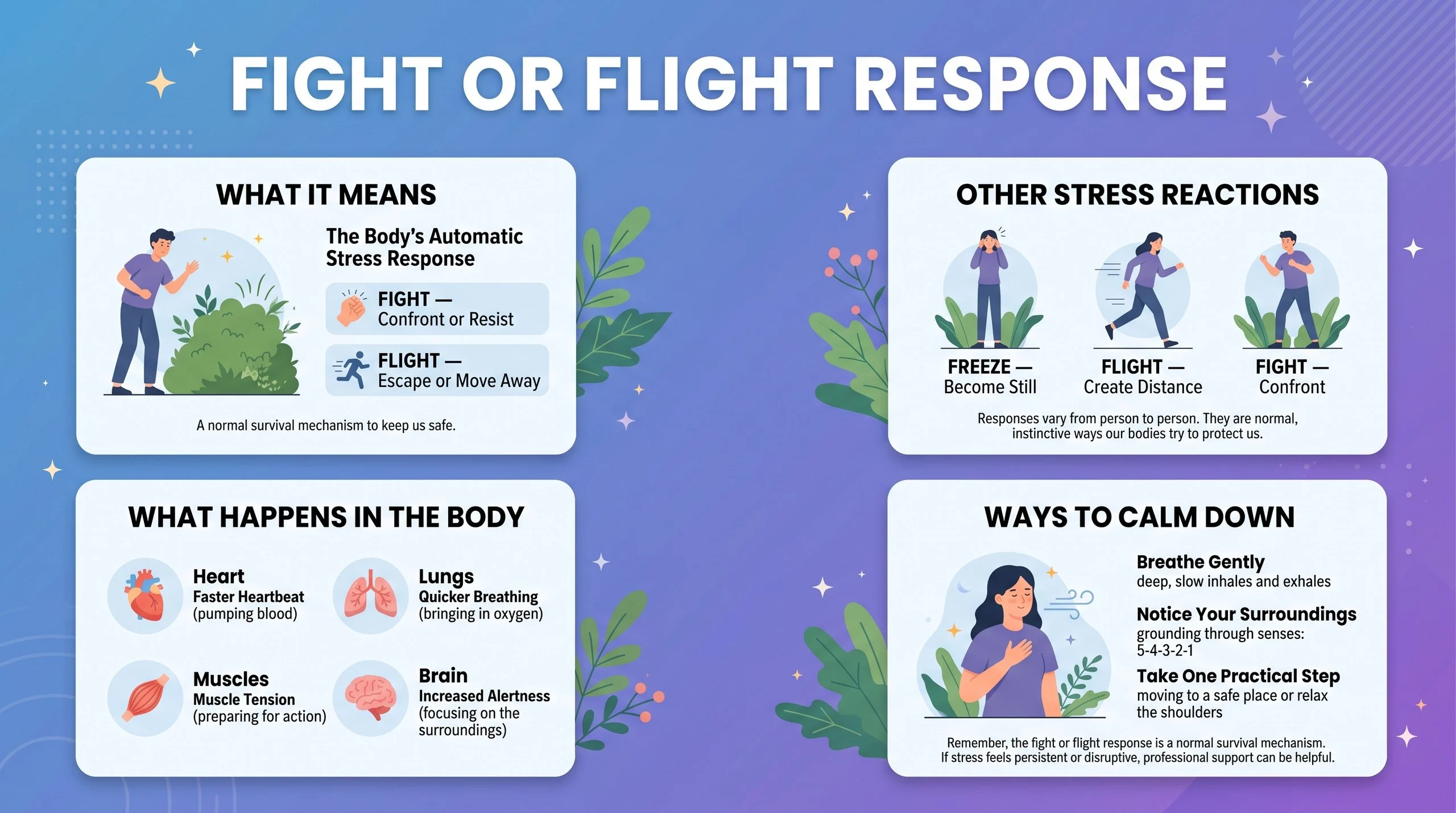
The fight or flight response is the body’s natural reaction to a perceived threat or danger. It prepares you to confront the threat or escape from it by increasing your heart rate, breathing, alertness, and energy. This automatic survival response is part of the body’s stress system.
The fight or flight response is an automatic reaction that helps your body respond to danger, stress, or a situation that feels threatening. It can happen when you face a real physical threat, give a speech, experience a sudden scare, or deal with an intense conflict. Your body prepares to take action before you have time to think everything through.
During this response, your heart may beat faster, your breathing may become quicker, and your muscles may tense. These changes help prepare you to face a threat or move away from it. However, the response can also occur when a situation feels dangerous even if there is no immediate physical risk.
Understanding the fight or flight response can help you recognize stress signals, understand your reactions, and choose practical ways to calm your body. It is a normal survival mechanism, not a personal weakness.
1. What Is the Fight or Flight Response?
The fight or flight response is the body’s built-in survival reaction to a perceived threat. It activates systems that help you respond quickly when you believe something dangerous may happen.
The term describes two possible reactions:
- Fight: You prepare to confront or resist a threat.
- Flight: You prepare to escape or move away from a threat.
For example, imagine walking along a path when a dog suddenly runs toward you and begins barking aggressively. Your heart may race, your muscles may tighten, and you may quickly decide whether to stand your ground or move away.
These reactions can happen without conscious planning. Your brain detects a possible threat and sends signals that prepare your body for action.
Importantly, the response is not limited to physical danger. Your body may react similarly before a job interview, during an argument, or when you face an unexpected problem. In those situations, the threat may be social or emotional rather than physical.
2. How Does the Fight or Flight Response Work?
The fight or flight response involves the brain, nervous system, and hormones. These systems work together to help you respond to situations that seem threatening.
Step 1: Your brain detects a possible threat
Your brain processes information from your surroundings and evaluates whether something may be dangerous. The amygdala, a brain region involved in processing emotional significance and threats, plays an important role in this process.
However, threat detection involves several brain regions. The amygdala does not work alone.
Step 2: Your nervous system activates
When a threat is detected, the sympathetic nervous system can become more active. This system helps prepare your body for quick action.
As a result, your heart rate may rise, your breathing may speed up, and blood flow to your muscles may increase.
Step 3: Stress hormones are released
The adrenal glands release adrenaline, also called epinephrine. This hormone helps increase alertness and prepares your body for rapid movement.
The body’s stress response may also involve the hormone cortisol. Its effects develop through a related but slower system, helping regulate the body’s response to ongoing stress.
Step 4: Your body prepares to act
You may feel energized, tense, shaky, or unusually alert. Your attention may focus on the possible danger, making other details less noticeable.
Finally, you may confront the situation, move away, freeze momentarily, or use another response depending on the circumstances.
3. Common Symptoms of the Fight or Flight Response
The fight or flight response can affect your body, thoughts, and emotions. Symptoms vary from person to person and depend on the situation.
Physical symptoms
Common physical signs include:
- Faster heartbeat
- Rapid or shallow breathing
- Sweating
- Muscle tension
- Shaking or trembling
- Dry mouth
- Stomach discomfort
- Increased alertness
- Feeling hot or flushed
- A sudden burst of energy
Not everyone experiences all these symptoms. Some people notice a racing heart first, while others feel tension in their shoulders, stomach, or hands.
Emotional symptoms
You may also experience:
- Fear or anxiety
- Irritability
- Restlessness
- A strong urge to escape
- Feeling overwhelmed
- Difficulty relaxing
Changes in thinking
Stress can affect attention and decision-making. You might find it harder to concentrate, remember details, or think through several options.
For instance, a student who feels anxious during an exam may know the answer but struggle to recall it immediately. Once the stress settles, the answer may become easier to remember.
These symptoms can be normal in stressful situations. However, frequent, intense, or unexplained symptoms may deserve professional attention.
4. Real-Life Examples of the Fight or Flight Response
The response can occur in everyday situations, not just emergencies.
Example 1: A sudden physical threat
You are crossing a street when a car approaches unexpectedly. Your heart races, your muscles tense, and you jump back onto the sidewalk.
Your body has prepared you to move quickly in response to a possible danger.
Example 2: Public speaking
You are about to speak in front of a large audience. Your palms become sweaty, your breathing speeds up, and you feel nervous.
Even though you are not facing a physical attack, your brain may interpret the situation as a threat to your social standing or sense of safety.
Example 3: An argument
Someone suddenly raises their voice during a disagreement. You feel your body tense and your anger rise. You may want to argue back or leave the room.
These urges can reflect a stress response. Taking a pause can help you decide how to respond instead of acting automatically.
Example 4: A frightening surprise
You hear a loud crash in another room. Your heart jumps, and you immediately turn toward the sound.
Your body has reacted quickly before you know what caused the noise.
Example 5: A stressful deadline
You realize that an important assignment is due soon. You feel restless and find it difficult to focus.
Although the deadline is not a physical threat, the pressure may trigger stress-related reactions.
These examples show that the fight or flight response can be useful during danger but uncomfortable when it happens in situations that do not require immediate action.
5. Fight, Flight, Freeze, and Fawn: What’s the Difference?
Fight and flight are commonly discussed as stress responses, but they are not the only possible reactions. People may also freeze or respond by trying to appease a perceived threat.
| Response | What it can look like | Example |
|---|---|---|
| Fight | Confronting, resisting, or defending yourself | Firmly telling someone to stop threatening you |
| Flight | Escaping, avoiding, or creating distance | Leaving an unsafe area |
| Freeze | Becoming still, stuck, or unable to act immediately | Going quiet during a frightening confrontation |
| Fawn | Trying to appease someone to reduce a perceived threat | Agreeing to unreasonable demands out of fear |
The term fawn response is used in some discussions of trauma and stress, but it is not a universally established category in the same way as the basic fight-or-flight model.
These reactions are not always conscious choices. A person may experience more than one response, and the reaction may change as a situation develops.
Freezing, for example, does not necessarily mean someone is weak or unwilling to act. It can be an automatic reaction to feeling overwhelmed or threatened.
6. Why Does the Fight or Flight Response Happen?
The response evolved to help humans deal with situations that may require quick action. It can provide a temporary advantage when a person needs to protect themselves or escape danger.
Today, the same system can respond to both physical and psychological stressors.
Real danger
A dangerous animal, an approaching vehicle, or an immediate physical threat can activate the response. Increased alertness and rapid movement may help you protect yourself.
Social pressure
A presentation, difficult conversation, or job interview may create a sense of being judged. Your body can react even though you are not in physical danger.
Uncertainty
Waiting for important news or facing an unfamiliar situation can make you feel threatened by the possibility of a negative outcome.
Past experiences
Previous frightening or stressful experiences may influence how someone responds to certain reminders. A sound, place, or interaction may trigger a strong reaction because it resembles something distressing from the past.
Nevertheless, a stress reaction alone does not prove that someone has experienced trauma or has a mental health condition.
7. Is the Fight or Flight Response Good or Bad?
The fight or flight response is neither inherently good nor bad. Its usefulness depends on the situation and how frequently it occurs.
When it helps
- It prepares you to respond to immediate danger.
- It increases alertness during a demanding situation.
- It can help you react quickly when time matters.
- It temporarily mobilizes energy for physical action.
When it becomes difficult
Problems can arise when the response activates frequently or remains difficult to settle after a stressful event.
Repeated stress may contribute to sleep difficulties, muscle tension, irritability, and trouble concentrating. Ongoing stress can also affect physical and emotional well-being.
For example, a little nervousness before an interview may help you prepare. However, if fear regularly prevents you from attending interviews, it may be helpful to learn stress-management strategies or seek professional support.
The goal is not to eliminate the fight or flight response. Instead, the goal is to recognize when it is useful and help your body settle when immediate action is no longer needed.
8. How to Calm the Fight or Flight Response
You cannot always prevent your body from reacting to stress. However, you can use simple techniques to help reduce the intensity of the reaction.
1. Slow down your breathing
Try breathing gently and comfortably, allowing your exhale to last slightly longer than your inhale. Avoid forcing deep breaths or holding your breath if that feels uncomfortable.
For example, inhale gently for about four seconds and exhale for about six seconds, adjusting the timing to what feels natural.
Stop if you feel dizzy or uncomfortable.
2. Notice your surroundings
Grounding techniques can help redirect your attention from frightening thoughts to the present moment.
Try naming five things you can see, four things you can feel, and three things you can hear. You can also notice the feeling of your feet against the floor.
3. Relax tense muscles
Stress often causes people to tighten their jaw, shoulders, hands, or stomach. Gently lower your shoulders, unclench your jaw, and relax your hands.
You do not need to force your body to relax immediately. Small changes can help you feel more comfortable.
4. Move to a safer or calmer place
If you are facing a real threat, prioritize safety. Move away from danger when possible and seek help if needed.
If the situation is emotionally intense but physically safe, taking a short break may help you think more clearly.
5. Focus on the next practical step
Stress can make a problem feel larger than it is. Break it into one manageable action.
For example, if you feel overwhelmed by a deadline, identify the first task you can complete rather than trying to solve everything at once.
6. Support your everyday well-being
Regular physical activity, adequate sleep, balanced meals, and supportive relationships can help you manage stress over time.
If your reactions are frequent, severe, or interfere with daily life, consider talking with a qualified healthcare professional.
9. Fight or Flight Response vs. Anxiety
The fight or flight response and anxiety are related, but they are not the same thing.
The fight or flight response is a body reaction that prepares you to respond to a perceived threat. Anxiety is an emotional state that can involve worry, fear, and anticipation of possible danger.
| Feature | Fight or flight response | Anxiety |
|---|---|---|
| Main description | Automatic stress reaction | Feeling of worry or apprehension |
| Common trigger | A perceived immediate threat | An immediate or anticipated threat |
| Physical symptoms | May include sweating, rapid heartbeat, and muscle tension | May include similar physical symptoms |
| Duration | Often settles as the threat passes | Can persist before, during, or after a stressful event |
| Meaning | A normal survival mechanism | Can be a normal feeling or part of an anxiety-related condition |
The two can occur together. For example, a person who worries about public speaking may experience anxiety beforehand and notice a racing heart when stepping onto the stage.
However, occasional anxiety or a racing heart does not automatically mean someone has an anxiety disorder. A professional can help assess persistent or disruptive symptoms.
Frequently Asked Questions
1. What is the fight or flight response in simple terms?
It is the body’s automatic reaction to a perceived threat. It prepares you to confront danger or move away from it by changing your heart rate, breathing, alertness, and muscle activity.
2. What triggers the fight or flight response?
Physical danger, sudden surprises, arguments, public speaking, deadlines, and other stressful situations may trigger it. The response can occur even when the threat is emotional rather than physical.
3. What hormone is responsible for the fight or flight response?
Adrenaline plays a major role in the body’s rapid response to stress. Cortisol is also involved in the broader stress response, particularly through a slower hormonal pathway.
4. How long does the fight or flight response last?
The most noticeable physical effects may begin to settle within minutes after a threat passes, but the duration varies. Continued stress, uncertainty, and individual differences can affect how quickly someone feels calm again.
5. Can you control your fight or flight response?
You may not be able to stop the initial automatic reaction. However, gentle breathing, grounding, relaxing tense muscles, and moving to a safe place can help you manage it.
6. What is the difference between fight, flight, and freeze?
Fight involves confronting or resisting a threat. Flight involves escaping or creating distance. Freeze may involve becoming still or temporarily unable to act. These responses can vary between people and situations.
7. Is the fight or flight response the same as a panic attack?
No. The fight or flight response is a normal stress mechanism. A panic attack is an episode of intense fear or discomfort that can include symptoms such as a racing heart, trembling, and shortness of breath. Similar symptoms can have other causes, so severe or unfamiliar symptoms should not automatically be attributed to stress.
8. When should you seek help for frequent fight or flight reactions?
Consider professional support if these reactions happen often, cause significant distress, interfere with sleep or everyday activities, or lead you to avoid important situations. Seek urgent medical attention for severe or new symptoms that could indicate a medical emergency.
Conclusion
The fight or flight response is a natural survival mechanism that prepares your body to respond to perceived danger. It can increase your heart rate, speed up your breathing, and sharpen your alertness so you can act quickly. Although this response is useful in emergencies, it may also appear during everyday stress, such as public speaking or difficult conversations. Recognizing your symptoms can help you respond with greater awareness. Gentle breathing, grounding exercises, and taking a safe pause may help your body settle. If these reactions become frequent or disrupt daily life, professional support can help you manage them.

Andrew Morris is a writer at Meaninga.com who specializes in word meanings, slang, idioms and modern language trends. He creates clear, accurate and easy to understand content for everyday readers.