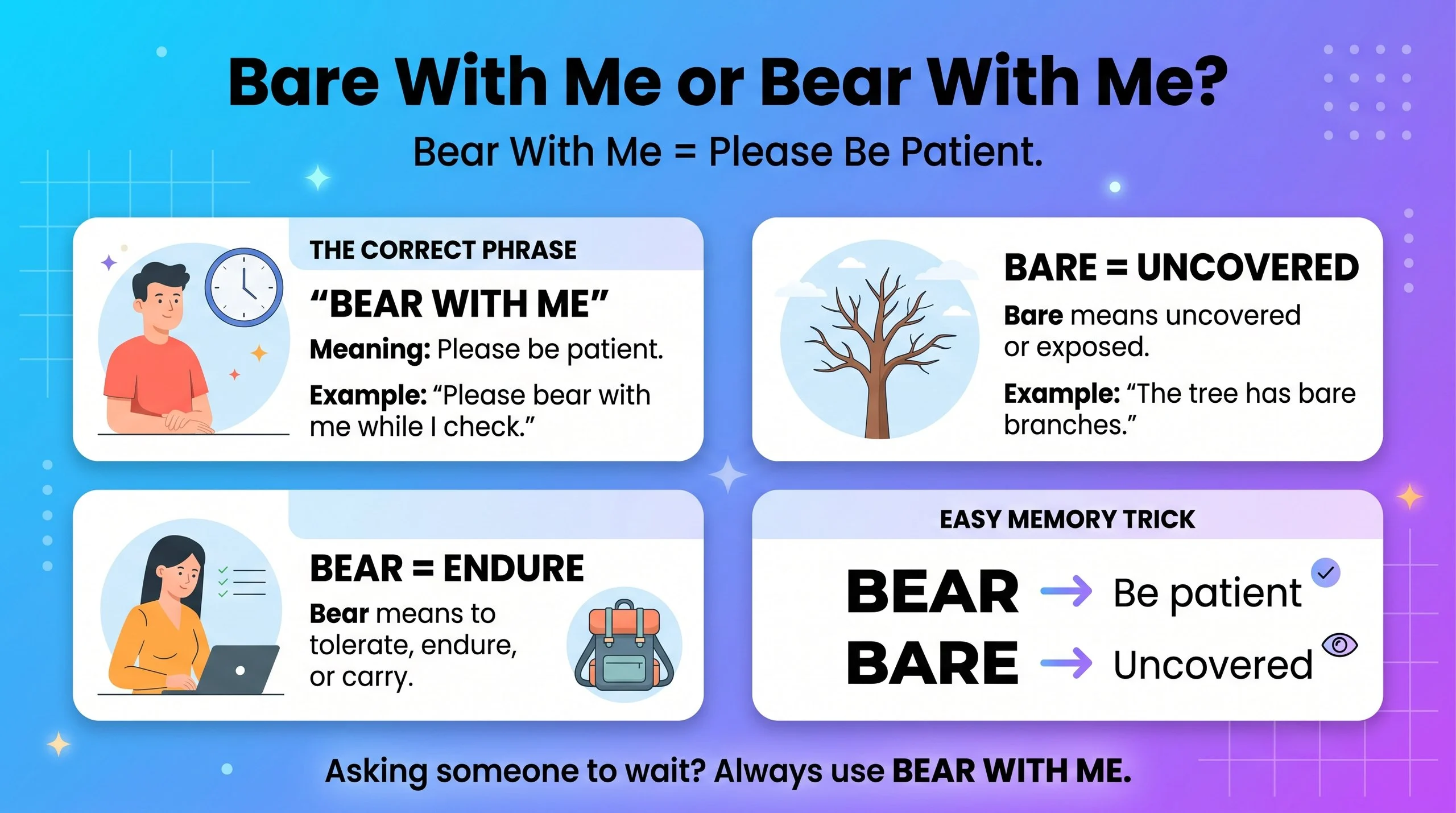
“Bear with me” is the correct expression when asking someone to be patient or wait. The verb bear means to tolerate or endure something. “Bare with me” is usually incorrect in this context because bare means to uncover or expose something.
Have you ever wondered whether to write “bare with me” or “bear with me”? These phrases sound exactly alike, so it is easy to mix them up. However, they have different meanings, and only one is correct when you ask someone to be patient.
The correct expression is “bear with me.” It politely asks someone to wait, remain patient, or tolerate a brief delay. For example, you might say, “Please bear with me while I find the document.”
On the other hand, bare means to uncover, reveal, or expose something. Therefore, “bare with me” does not express the intended meaning. This guide explains the difference, provides simple examples, and shares an easy trick to help you remember the correct phrase.
Bear With Me or Bare With Me?
| Phrase | Meaning | Correct Usage |
|---|---|---|
| Bear with me | Be patient with me | “Please bear with me while I check.” |
| Bare with me | Literally, uncover or expose with me | Not correct when asking for patience |
| Bear | Tolerate or endure | “I can bear the delay.” |
| Bare | Uncovered or reveal | “The tree had bare branches.” |
Remember: If you want someone to be patient, write “bear with me.”
What Does “Bear With Me” Mean?
“Bear with me” means “please be patient with me.” It is a polite expression used when you need a little extra time, want someone to wait, or need understanding while you handle something.
The word bear is a verb meaning to tolerate, endure, or deal with something difficult or inconvenient.
For example:
- “Please bear with me while I restart the computer.”
- “Bear with me; I’m still learning.”
- “Thanks for bearing with me during the delay.”
- “Please bear with me while I explain the details.”
In each example, the speaker asks for patience.
The expression is common in everyday conversation, workplace emails, customer service, presentations, and online meetings.
What Does “Bare With Me” Mean?
The words “bare with me” are grammatically possible in a literal context, but they do not mean “be patient with me.”
The word bare means to uncover, expose, or reveal something. For example, “bare your arm” means to expose your arm.
Therefore, the phrase “bare with me” could be interpreted literally as asking someone to uncover or expose themselves alongside you. This is not the intended meaning in ordinary requests for patience.
Examples of the correct use of bare include:
- “The tree had bare branches.”
- “He wore shoes on his bare feet” is incorrect wording; you would say “He went barefoot.”
- “The report revealed the bare facts.”
- “She decided to bare her feelings.”
Consequently, if you are asking someone to wait, do not use “bare with me.”
Why Is “Bear With Me” Correct?
The expression uses the verb bear, which means to tolerate or endure something.
When you say “bear with me,” you are asking another person to tolerate a delay, follow your explanation, or remain patient while you complete a task.
For example:
“Please bear with me while I look for your order.”
The customer is being asked to wait patiently.
Similarly:
“Bear with me while I explain how this works.”
The speaker wants the listener to give them time to explain.
The expression follows the same meaning of bear found in phrases such as “bear the responsibility,” “bear the cost,” and “bear the pain.”
Bear vs. Bare: What Is the Difference?
Although bear and bare sound alike, they have different meanings.
Bear
Bear can be a verb or a noun.
As a verb, it can mean to tolerate, endure, carry, or support something.
Examples:
- “I cannot bear the noise.”
- “She had to bear the responsibility.”
- “Please bear with me.”
- “The tree will bear fruit.”
As a noun, bear refers to the animal.
Example:
- “We saw a bear in the forest.”
Bare
Bare usually means uncovered, exposed, or without something.
Examples:
- “He walked across the floor with bare feet.”
- “The tree had bare branches.”
- “She revealed her bare emotions.”
- “The room had bare walls.”
Therefore, remember that bear relates to enduring or carrying, while bare relates to being uncovered or exposed.
Examples of “Bear With Me” in Sentences
Here are natural examples of the correct expression.
Everyday Conversation
- “Bear with me while I get my keys.”
- “Please bear with me for a moment.”
- “Bear with me; I’ll explain everything.”
- “Thanks for bearing with me.”
Professional Emails
- “Please bear with me while I review your request.”
- “We appreciate your patience as we resolve this issue.”
- “Kindly bear with me while I confirm the details.”
Customer Service
- “Please bear with me while I check your account.”
- “Thank you for bearing with us during maintenance.”
- “Bear with me while I connect you to the right department.”
School and Presentations
- “Please bear with me as I explain the next step.”
- “Bear with me while I work through this example.”
- “I appreciate you bearing with me during my presentation.”
These examples show that the phrase works in both casual and formal settings.
Is “Bear With Me” Formal or Informal?
“Bear with me” works in both formal and informal situations.
In casual conversations, you might say:
“Bear with me a sec. I’m almost ready.”
In a professional email, you could write:
“Please bear with me while I review the information.”
The expression is generally polite. However, if you are writing to a customer or someone who has already waited a long time, acknowledging the delay and thanking them for their patience may sound more considerate.
For example:
“Thank you for your patience while I look into this matter.”
This alternative is especially useful in customer service and professional communication.
Alternatives to “Bear With Me”
If you want to avoid the expression or make your message sound different, several alternatives work well.
| Alternative | Best Use |
|---|---|
| Please be patient with me. | Direct and clear |
| Give me a moment. | Casual situations |
| Please wait a moment. | Simple requests |
| Thank you for your patience. | Professional communication |
| Thanks for waiting. | Friendly, informal situations |
| I appreciate your understanding. | Polite or professional requests |
| Please allow me a little more time. | Formal situations |
For example, instead of writing “Bare with me while I check,” write “Please give me a moment while I check.”
Common Mistakes With Bear and Bare
Mistake 1: Writing “Bare With Me” in an Email
Incorrect: “Bare with me while I review your application.”
Correct: “Bear with me while I review your application.”
The correct verb is bear because you are asking the reader to be patient.
Mistake 2: Thinking “Bare” Is a Shorter Version of “Bear”
These words are not interchangeable. They have different meanings, even though they sound alike.
Mistake 3: Using the Wrong Word in “Thanks for Bearing With Me”
Incorrect: “Thanks for baring with me.”
Correct: “Thanks for bearing with me.”
Here, bearing means tolerating or being patient during a delay.
Mistake 4: Assuming “Bear With Me” Is Only for Formal Writing
The expression works in casual texts, everyday conversations, presentations, and professional emails.
Mistake 5: Confusing “Bear With Me” and “Bare Your Feelings”
Both expressions are correct, but they use different verbs. “Bear with me” asks for patience, while “bare your feelings” means to reveal your feelings.
Frequently Asked Questions
1. Is it “bare with me” or “bear with me”?
“Bear with me” is correct when asking someone to be patient or wait. The word bear means to tolerate or endure. Bare means to uncover or expose something, so it does not fit this expression.
2. What does “bear with me” mean?
“Bear with me” means “please be patient with me.” People use it when they need more time, are explaining something, or are handling a delay. It is common in both professional and casual communication.
3. Is “bare with me” ever correct?
It can be grammatically possible in a literal situation involving uncovering or exposing something with another person. However, it is not correct when you intend to ask someone to wait or be patient.
4. Why do people confuse bear and bare?
The words bear and bare are homophones, meaning they sound alike but have different meanings and spellings. Because their pronunciation is identical, writers sometimes choose the wrong word when typing the expression.
5. Is “please bear with me” polite?
Yes. “Please bear with me” is a polite way to ask for patience while you complete a task, explain something, or resolve a problem. In professional situations, you can also thank the other person for their patience.
6. Is it “thanks for bearing with me” or “thanks for baring with me”?
The correct phrase is “thanks for bearing with me.” The word bearing means tolerating or being patient with a situation. Baring relates to uncovering or revealing something.
7. Can I use “bear with me” in a work email?
Yes. You can write, “Please bear with me while I review your request.” It is appropriate for workplace communication. For a softer tone, you might write, “Thank you for your patience while I review your request.”
8. What is an easy way to remember the correct phrase?
Connect bear with endure. If you are asking someone to tolerate a delay, use “bear with me.” Connect bare with uncovered, as in bare feet or bare walls.
Conclusion
The correct expression is “bear with me” when asking someone to be patient. The word bear means to tolerate or endure, while bare means uncovered or exposed. Although both words sound alike, their meanings are different. For example, “Please bear with me while I check” politely asks someone to wait. By contrast, “bare branches” describes branches without leaves.
To remember the rule, connect bear with patience and endurance, and bare with something uncovered. Once you understand this distinction, you can confidently use the correct expression in texts, emails, conversations, and professional writing.