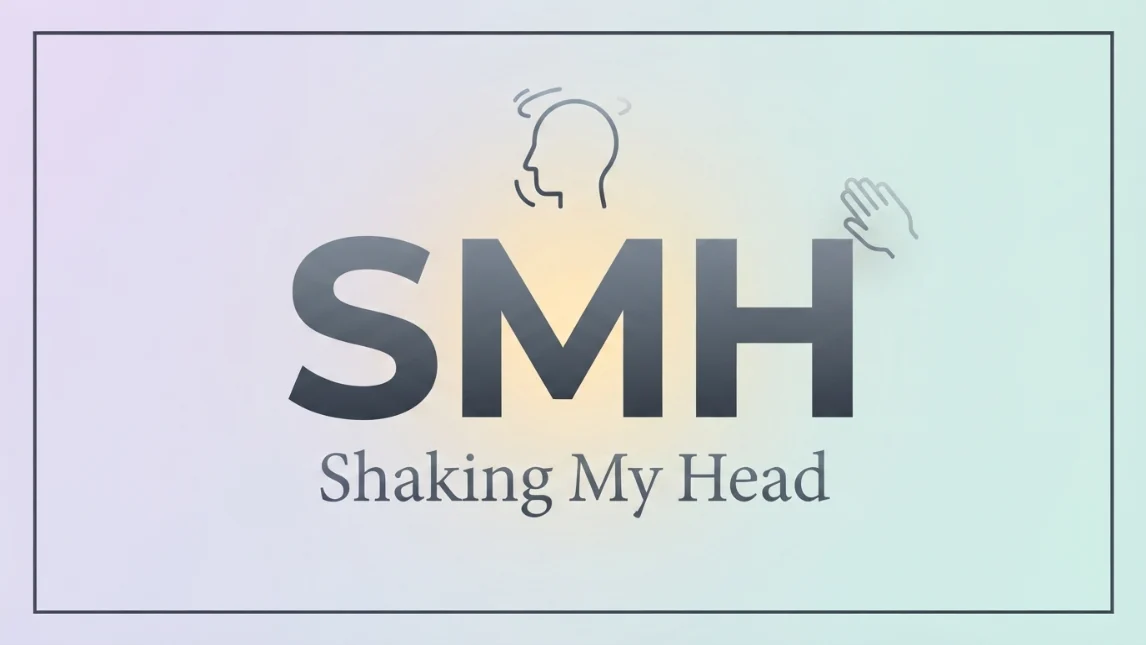
SMH stands for “shaking my head.” People use this popular internet acronym in text messages and across social media platforms to express disappointment, disapproval, frustration, or disbelief. For example, if someone shares a frustrating story, you might reply with “SMH” to show that you are visually shaking your head in exasperation.
Internet culture evolves at a rapid pace, yet certain acronyms stand the test of time. If you have spent any time scrolling through TikTok, reading X (formerly Twitter) threads, or chatting in group texts, you have likely encountered the term SMH.
While internet slang can sometimes feel like a completely foreign language, mastering these digital shorthand expressions is essential for modern communication. This comprehensive guide will break down the exact meaning of SMH, explore its semantic origins, analyze platform-specific nuances, and provide practical examples so you can use it naturally in your daily digital conversations.
Quick Answer Box
| Attribute | Details |
| Primary Meaning | Shaking My Head |
| Core Emotion | Disappointment, frustration, disbelief, or mild annoyance |
| Common Platforms | TikTok, Snapchat, Instagram, X (Twitter), iMessage, WhatsApp |
| Typical Example | “He forgot his keys for the third time this week. SMH.” |
| Tone | Informal, casual, text-style, lowkey judgmental |
What Does SMH Mean?
Full Definition
The acronym SMH stands directly for “shaking my head.” It serves as a digital stage direction, translating a physical human gesture into a three-letter textual format. When you physically shake your head from side to side, you are usually expressing disapproval, disbelief, or disappointment. Consequently, typing SMH communicates that exact physical reaction to your reader without requiring a video or an emoji.
Linguistic Origins and History
While SMH feels like a modern invention, its roots trace back to the early days of the internet. The term first began appearing in online chat rooms, Urban Dictionary entries, and early bulletin board systems (BBS) during the early 2000s. As mobile texting limits forced users to abbreviate their thoughts, SMH grew rapidly in popularity alongside other classic acronyms like LOL (laugh out loud) and BRB (be right back).
Semantic Variations
Over time, internet users have adapted the core meaning of SMH to fit various emotional intensities. Depending on the context of your conversation, SMH can mean:
- Literal Disappointment: Expressing genuine sadness or letdown regarding someone’s actions.
- Sarcastic Disbelief: Signifying amusement at how ridiculous or absurd a situation is.
- Exasperation: Showing that you are utterly tired or exhausted by a repetitive, negative behavior.
Context & Usage
Understanding the definition of SMH is only the first step; consequently, mastering its context is where you achieve true digital fluency. Because text lacks vocal tone and facial expressions, placement and context dictate how your message will be received.
Texting and Casual Conversations
In peer-to-peer text messages, SMH typically acts as a reactionary punctuation mark. You can place it at the very beginning of a sentence to establish your mood, or you can append it to the end of a statement to add a layer of casual judgment.
Social Media Commentaries
On public feeds, users leverage SMH to react to news stories, viral videos, or political events. In this space, it signals a collective sense of cultural fatigue or disappointment. For example, if a major sports team loses a game due to a simple mistake, fans will flood the comment sections with “SMH” to voice their shared frustration.
Real-Life Examples
To help you fully grasp how this slang functions in daily life, let us examine several realistic text dialogues across different scenarios.
Group Chat Frustration
- User A: “Did Marcus really back out of our road trip at the very last minute?”
- User B: “Yeah, he said he forgot he had a family dinner. SMH, he does this literally every single time.”
Reaction to Bad Luck
- User A: “I dropped my phone in the sink this morning and the screen completely died.”
- User B: “Oh no, fr? SMH that is the absolute worst luck.”
Workplace Relatability (Casual)
- User A: “The management just sent an email saying the coffee machine is broken again.”
- User B: “SMH, we genuinely cannot have nice things in this office.”
Academic Annoyance
- User A: “The professor assigned a 10-page essay over the holiday weekend.”
- User B: “No cap? SMH, that should lowkey be illegal.”
Sports Disappointment
- User A: “Our team missed three penalty kicks in a row tonight.”
- User B: “I saw that. SMH, I had to turn the TV off.”
Platform-Specific Meaning
While the core definition remains identical across the web, different apps embrace distinct cultural variations of SMH.
TikTok
On TikTok, SMH is frequently paired with specific video formats or visual trends. Users write SMH in video captions or on-screen text overlays when showcasing relatable “fails,” bad dating experiences, or confusing life moments. Furthermore, creators often combine the text with a literal video of themselves looking into the camera and shaking their heads to emphasize the vibe.
Snapchat
Snapchat communication is fast and highly visual. Because of this, SMH is commonly overlaid on top of photos or short video snaps. If a friend snaps a picture of a massive traffic jam or a messy room, adding “SMH” provides instant context without cluttering the image with long sentences.
X (Formerly Twitter)
X thrives on breaking news, viral commentary, and sharp opinions. Therefore, SMH is heavily utilized on this platform to react to trending news, political updates, or celebrity drama. It allows users to express their opinion within tight character limits, serving as a swift, universally understood critique.
On Instagram, you will find SMH primarily within the comment sections of meme pages or news outlets. When an account posts a frustrating or bizarre story, users type SMH to build solidarity with other commenters who share the same sense of disbelief.
Alternative Meanings
While “shaking my head” represents the vast majority of usages, internet linguistics occasionally births alternative interpretations. It is vital to recognize these outliers so you do not misinterpret a niche conversation.
SMH as “So Much Hate”
In rare online subcultures—particularly within gaming communities or intense fandom disputes—some individuals interpret SMH as “so much hate.” For instance, if a user receives numerous critical comments, they might reply with, “Wow, SMH in this thread.” However, this usage is largely outdated, as the primary definition has thoroughly dominated mainstream digital spaces.
SMH as “Scratching My Head”
Occasionally, older generations or newer internet users mistakenly use SMH to mean “scratching my head.” In this context, they are attempting to convey confusion rather than disappointment. Although the emotional nuance differs slightly, the general sentiment of bewilderment remains relatively close to the original meaning.
Related Terms & NLP Variations
To build a robust semantic understanding of internet slang, you should know how SMH relates to other common abbreviations.
SMDH (Shaking My Damn Head)
When standard disappointment is simply not enough, users upgrade the acronym to SMDH. The addition of the “D” adds emphasis and intensity, signaling that the situation is profoundly frustrating or utterly absurd.
SMHBH (Shaking My Head Behind Hypocrisy)
This is a highly specific, niche variation used primarily in political or social justice commentaries. It targets individuals who preach one set of values while practicing another.
Comparative Slang Table
| Acronym | What It Stands For | Primary Emotion |
| SMH | Shaking My Head | Disapproval / Disbelief |
| SMDH | Shaking My Damn Head | Intense Frustration |
| LMF | Facepalm | Realization of Ignorance |
| TFW | That Feeling When | Relatability / Empathy |
| BRH | Bruh | Absolute Shock / Exhaustion |
How to Respond to SMH
Receiving an “SMH” in a text exchange can sometimes feel slightly ambiguous. How you respond depends entirely on whether the disappointment is directed at you, a third party, or a general situation.
When the Frustration is Shared (Third Party)
If a friend uses SMH to complain about an external situation, you should validate their feelings. You can mirror their energy by using matching slang or emojis.
- Example Reply: “I know, right? It makes absolutely no sense, fr.”
When You Are the Cause of the SMH
If you made a silly mistake or forgot an appointment, a friend might text you “SMH” playfully or seriously. In this scenario, own up to the blunder with humor or a quick apology.
- Example Reply: “My bad! 💀 I completely lost track of time, I’ll be there in five.”
Using Emojis as a Reply
Sometimes, words are unnecessary. You can easily respond to an SMH message with a expressive emoji that conveys a matching sentiment:
- 🤦♂️ (Facepalm): Perfect for acknowledging a ignorant situation.
- 🙄 (Eye Roll): Great for showing mutual annoyance.
- 😭 (Loudly Crying Face): Ideal for laughing at your own misfortune.
Misinterpretations
Because acronyms are compact, they run a high risk of misinterpretation—especially across generational gaps.
The Aggression Misconception
Older adults or individuals unfamiliar with digital texting patterns may occasionally view SMH as hostile or overly aggressive. They might interpret the subtle judgment as a genuine, harsh insult rather than a casual expression of everyday frustration. Therefore, remember to consider your recipient’s digital literacy before deploying text slang.
Confusion with Texting Jargon
New internet users sometimes confuse SMH with similar-looking acronyms like SJH (which has no meaning) or SMR (shaking my rump). Ensuring that you understand the exact sequence of letters prevents confusing communication breakdowns.
When NOT to Use It
Slang possesses specific boundaries. Using internet jargon in the wrong environment can damage your credibility or distort your message entirely.
Professional and Academic Communication
You should never use SMH in formal contexts. Avoid putting it in emails to supervisors, cover letters, academic essays, or professional slack channels. Using slang in these spaces can make you appear unprofessional, careless, or disrespectful.
- Instead of: “The client changed their mind again, SMH.”
- Use: “The client has updated their requirements once more, which will require us to adjust our timeline.”
Serious or High-Stakes Situations
If someone is sharing tragic news, discussing a serious health issue, or venting about a deeply painful personal matter, SMH is entirely inappropriate. It downplays the emotional gravity of the situation and can seem incredibly dismissive or insensitive.
Usage Tips
To naturally integrate SMH into your everyday vocabulary without sounding forced or unnatural, keep these essential formatting and stylistic tips in mind.
Capitalization Doesn’t Matter
In the world of casual text message communication, capitalization is entirely optional. You can write SMH in all capital letters to emphasize your point, or keep it lowercase as smh to blend it smoothly into a casual statement.
Keep It Brief
Slang works best when it remains concise. Avoid stacking multiple acronyms back-to-back in a single sentence, as this can make your text difficult to read and diminish the overall impact of your message.
FAQs
1. What does SMH mean from a guy or a girl?
The meaning of SMH does not change based on gender. Both guys and girls use the acronym uniformly to express disappointment, disbelief, or mild annoyance regarding a specific situation.
2. Is SMH rude to use in a text?
Generally, SMH is not rude when used among friends in a casual conversation. However, because it expresses judgment or disapproval, using it to respond to someone’s genuine opinion can sometimes feel dismissive.
3. What is the difference between SMH and SMDH?
SMH stands for “shaking my head,” whereas SMDH stands for “shaking my damn head.” Consequently, SMDH represents a much stronger, more intense level of frustration or disbelief.
4. Can I use SMH in a work email?
No, you should avoid using SMH or any other informal internet slang in professional correspondence. Stick to clear, formal language when communicating with colleagues or clients.
5. What does SMH mean on TikTok captions?
On TikTok, creators use SMH in captions to signal that their video contains a relatable fail, an awkward encounter, or a funny but frustrating real-life situation.
6. Is SMH outdated slang?
Not at all. While internet slang changes rapidly, SMH remains a core staple of digital communication and continues to see heavy daily usage across all major social media platforms.
7. Does SMH mean “so much hate”?
While a tiny segment of internet users originally interpreted it as “so much hate,” the overwhelming mainstream definition is “shaking my head.”
8. How do you pronounce SMH?
People do not typically pronounce SMH as a single phonetic word. Instead, you pronounce it by spelling out the individual letters: S-M-H. Alternatively, when reading it silently, most people automatically translate it to the full phrase “shaking my head” in their minds.
9. What emoji represents SMH?
The 🤦♂️ (person facepalming) and the 🙄 (face with rolling eyes) emojis represent the closest visual match to the emotional sentiment of SMH.
10. Can SMH mean something positive?
Almost never. SMH inherently describes an act of disapproval or disbelief, making it fundamentally tied to neutral or negative situations.
Conclusion
Navigating the expansive landscape of internet acronyms can feel challenging at first, but mastering foundational terms like SMH instantly bridges the gap. By understanding that it translates to “shaking my head,” you unlock the ability to accurately express disappointment, disbelief, and casual amusement in your digital interactions.
Just remember to keep its usage restricted to informal platforms, pay attention to the surrounding emotional context, and adapt your tone to match your audience. With these insights in hand, you can confidently scroll, text, and comment like a true digital native.









1 thought on “SMH Meaning| What Does It Mean and How to Use It Correctly”