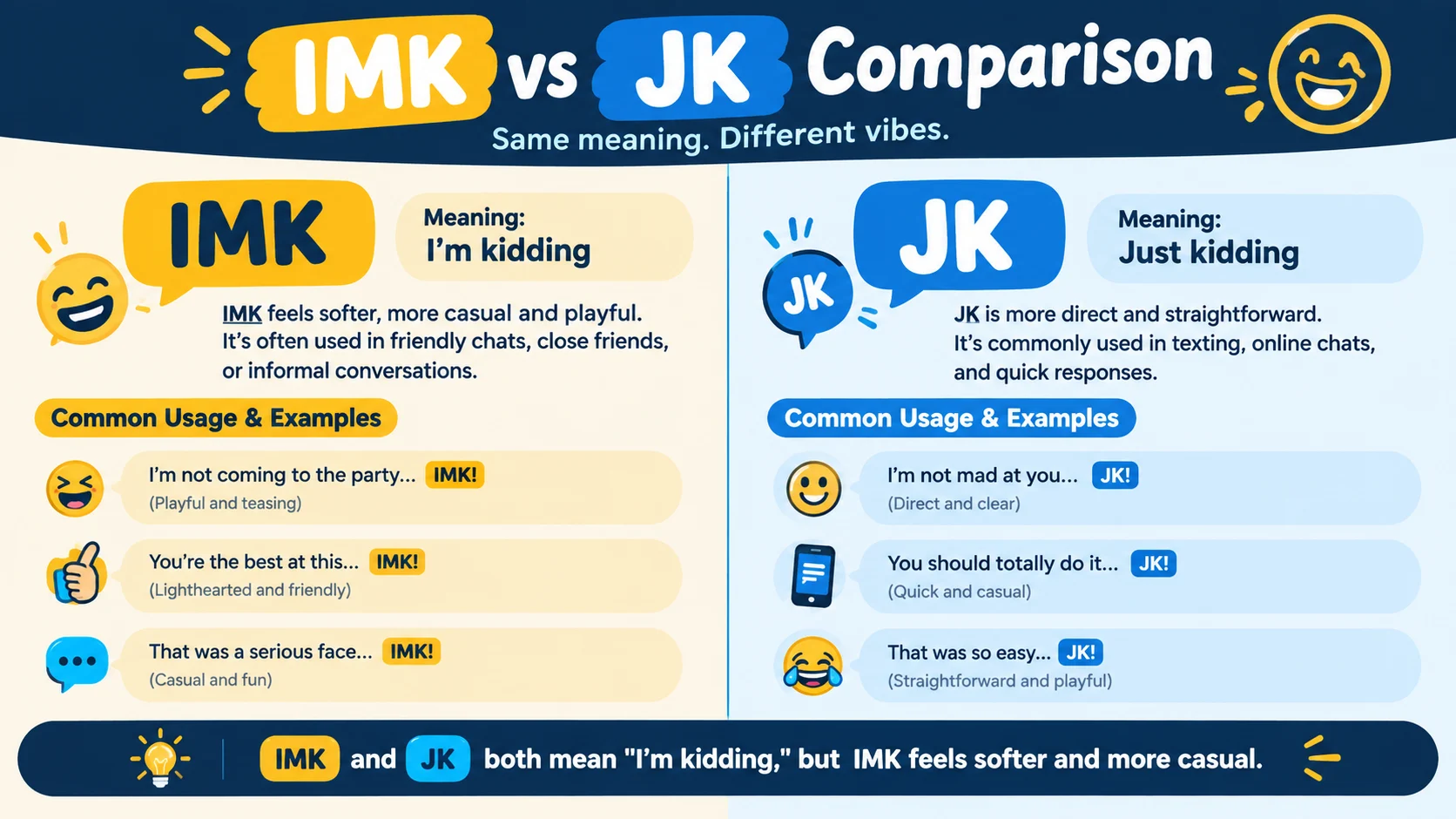
IMK stands for “I’m kidding” in text messaging and online conversations. It is used to clarify that a previous statement was meant as a joke, sarcastic remark, or playful tease. People use IMK to prevent misunderstandings when their tone might not be obvious in written form. It appears most frequently in casual chats on WhatsApp, Snapchat, TikTok, Instagram DMs, and gaming platforms. The acronym functions as a conversational reset button, letting the recipient know not to take the preceding message seriously.
- Meaning: I’m Kidding
- Context: Texting, social media, gaming
- Tone: Playful, apologetic, clarifying
- Usage: After a sarcastic or teasing statement
The internet has created an entirely new language. If you’ve ever stared at your phone screen wondering what someone just said, you’re not alone. Acronyms and abbreviations pop up constantly, making it hard to keep up especially if you’re over 25.
You might know that LOL means “laugh out loud” and BRB stands for “be right back.” You might even be familiar with IKR (“I know, right?”). But if you received a message with the letters IMK and had no idea what they meant, don’t worry you’re about to find out.
Here’s everything you need to know about what IMK means, how to use it correctly, and why it matters in modern digital communication. This guide covers real examples, platform breakdowns, common misinterpretations, and practical tips to use IMK like a pro.
Quick Answer Box
| Element | Details |
| Meaning | I’m Kidding |
| Context | Text messaging and online chat |
| Usage | To clarify that a previous statement was a joke or sarcastic remark |
| Platforms | WhatsApp, Snapchat, TikTok, Instagram, Twitter, Discord, gaming |
| Example | “You’re actually the worst at this game. IMK lol” |
| Tone | Playful, lighthearted, or apologetic |
What Does IMK Mean in Text?
IMK is an acronym that stands for “I’m kidding.”
It’s that simple. When someone types IMK in a text message, social media post, or online comment, they’re letting you know they were joking. It’s a tonal safety net.
In face-to-face conversations, people rely on vocal tone, facial expressions, and body language to understand when someone is joking. In written digital communication, those cues vanish. Acronyms like IMK help bridge that gap.
Instead of typing out “I’m kidding” every time you make a joke, you can just drop IMK. It’s faster, cleaner, and fits the casual nature of text-based conversation.
A Quick Linguistic Breakdown
IMK falls into the category of conversational clarifying acronyms short bursts of text designed to manage how your message is received. Others in this category include:
- JK (just kidding)
- S (sarcastic)
- ICYMI (in case you missed it)
- IMO/IMHO (in my opinion / in my humble opinion)
Among these, IMK serves a specific purpose: it’s a softer, more casual alternative to JK. While JK can sometimes feel abrupt or even passive-aggressive depending on context, IMK tends to land more gently.
Pro Tip: IMK works best when you’ve made a comment that could be easily misunderstood. It doesn’t replace JK it offers a slightly different vibe.
Full Definition and Core Meaning
IMK is shorthand for “I’m kidding.”
It’s used in digital communication text messages, social media platforms, gaming chats, and online forums to indicate that a previous statement was intended as a joke.
But let’s dig deeper.
The acronym works on two levels:
- Literal Meaning: “I’m kidding” = I am joking or teasing.
- Functional Meaning: This message should not be taken seriously.
When you send IMK, you’re essentially asking the recipient to reinterpret your previous statement with a lighter lens. It’s a tone reset.
When Did IMK Become Popular?
The acronym emerged organically in online messaging spaces. While it doesn’t have a documented origin date, its popularity spiked with the widespread use of SMS, instant messaging, and social media platforms. It’s a natural product of digital communication constraints: people needed a quick way to convey “I’m joking” without typing full words or resorting to emojis alone.
Gen Z and Millennials have heavily adopted IMK, though it appears across all age groups in casual digital conversation.
Context and Usage
Understanding IMK isn’t just about knowing what letters stand for it’s about grasping the social dynamics of when and how to use it.
Common Situations for IMK
- After Making an Over-the-Top Statement
- “Your taste in music is genuinely concerning. IMK lol”
- Adds a layer of playfulness to what might otherwise sound harsh.
- When You’ve Made a Self-Deprecating Joke
- “I’m basically a professional at burning water. IMK”
- Softens the self-criticism with humor.
- During Playful Teasing with Friends
- “You definitely chose the wrong career path. IMK please don’t cry”
- Signals that the tease isn’t meant to hurt.
- After a Sarcastic Comment
- “Oh yeah, that’s definitely a fantastic idea. IMK obviously”
- Clarifies that sarcasm is in play.
- When Testing the Waters with a Risky Joke
- “Honestly, you might be the least funny person I know. IMK”
- Provides an escape route if the joke lands wrong.
The Subtleties of IMK
- IMK vs. JK: Both mean “I’m kidding,” but IMK feels softer and more casual. JK can sound dismissive or defensive in some contexts. If you’ve made a truly harsh statement, JK might be the better choice because it’s more direct.
- IMK vs. Tone Tags: In some online communities, people use tone tags like /j for joke or /s for sarcasm. IMK serves a similar function but is more conversational and less formal.
- IMK and the Delivery of a Joke: The placement of IMK matters. Putting it at the end of a statement is standard. Putting it at the beginning changes the tone: “IMK, but you’re terrible at this” signals a joke from the start.
Important: IMK does NOT mean “I’m okay.” If someone is checking on your wellbeing, they would write something else entirely.
Real-Life Examples of IMK in Text Conversations
To understand IMK fully, you need to see it in action. These realistic text exchanges show how people use the acronym naturally.
Example 1: Two Friends Texting
Context: Two friends, Alex and Jordan, are texting about Alex’s new haircut. Alex is unsure about the result.
Alex: “I just got the worst haircut of my life.”
Jordan: “Send a pic.”
Alex: [sends photo]
Jordan: “Okay, that’s genuinely terrible. Did a dog chew your hair? IMK fr lol”
Alex: “LOL you’re actually the worst. But thank you for confirming my fears.”
Analysis: Jordan uses IMK to clarify that the joke is playful, not mean-spirited. The “fr” (for real) and “lol” add additional tonal context.
Example 2: Group Chat During a Game
Context: A group of three friends gaming online. They just lost a match. Taylor is new to the game.
Taylor: “Wait, I think I accidentally shot all of you.”
Sam: “BRO. How? IMK but that was genuinely impressive.”
Chris: “Sam, be nice. They’re learning.”
Taylor: “IMK too. I’ll get better eventually.”
Sam: “Fr this time. You’ve got potential.”
Analysis: Taylor uses IMK to show they’re also kidding about their own incompetence. Sam uses it to soften an otherwise blunt reaction.
Example 3: Texting a Crush
Context: Maya is texting her crush, Liam. They’ve been flirting lightly.
Maya: “You know, I only hang out with you because you’re entertaining.”
Liam: “Oh. Okay.”
Maya: “IMK! You’re actually really sweet.”
Liam: “Phew. Thought you hated me for a second.”
Analysis: IMK functions as a backup plan. Maya’s joke fell slightly flat, and IMK helped clarify the real sentiment behind it.
Example 4: Family Group Chat
Context: A family group chat discussing weekend plans.
Brother: “Mom, your cooking is definitely not the main reason I’m coming home. IMK ilysm (I love you so much).”
Mom: “You better be kidding.”
Sister: “He is. He’s just dramatic.”
Brother: “IMK fr. I love you and your food.”
Analysis: IMK helps reinforce the joke while expressing genuine affection. The accompanying “ilsym” adds emotional weight.
Example 5: Professional Slack Channel
Context: A colleague posts a mildly self-deprecating joke in a work Slack channel.
Raj: “I’m definitely winning employee of the month for most coffee consumed. IMK (mostly).”
Megan: “If that’s a category, you’re the undisputed champion.”
Analysis: Raj uses IMK to keep the tone light but leaves room by adding “(mostly)” to indicate there might be a grain of truth. In a professional setting, this careful tonal management is crucial.
Platform-Specific Meaning of IMK
IMK appears across multiple digital platforms, but its usage can shift slightly depending on the medium.
IMK in WhatsApp
WhatsApp is one of the most common platforms where IMK appears. People use it in one-on-one chats and group chats.
Characteristics:
- Casual and conversational
- Often paired with emojis for additional tonal clarity
- Used across all age groups
WhatsApp Example:
“We should definitely go to that restaurant again. Your reaction to the spice was iconic. IMK 😂”
IMK on Snapchat
On Snapchat, IMK often appears in captions, photo replies, and chat windows. Since Snapchat is heavily used by younger demographics, IMK is especially common.
Characteristics:
- Fast-paced and casual
- Often appears in photo captions or Snap replies
- Paired with stickers, filters, and Bitmojis
Snapchat Example:
[Photo of friend making a weird face] “This is going on my wall. IMK”
IMK on TikTok
TikTok’s comment sections are a breeding ground for acronyms. IMK appears in comments, DMs, and video captions.
Characteristics:
- Used to clarify when a comment is teasing rather than hateful
- Often appears with “lol,” “fr,” or “no cap”
- Creates a sense of inside-joke culture
TikTok Example:
Comment: “This is literally me every morning. IMK the struggle is real.”
IMK on Instagram DMs and Comments
Instagram’s culture is more visual, but the DMs and comments are text-heavy. IMK helps bridge the gap between curated visual content and casual conversation.
Instagram Example:
“You’re only posting this photo because you look good. IMK fr 🔥”
IMK in Gaming (Discord, Xbox, PlayStation)
Gaming culture heavily uses IMK. Teasing and trash-talking are common, and IMK is a way to keep it sportsmanlike.
Gaming Example:
“GG but you’re actually terrible at this map. IMK dude, you’ll get better.”
Platform Usage Summary Table:
| Platform | Common Usage | Typical Tone |
| Group chats, one-on-one | Casual, family/friends | |
| Snapchat | Captions, replies | Playful, young |
| TikTok | Comments, DMs | Edgy, humorous |
| DMs, comments | Visual + casual | |
| Discord | Gaming chats | Competitive, lighthearted |
| Tweets, replies | Sarcastic, witty | |
| Comments, groups | Mixed demographics |
Alternative Meanings of IMK
IMK is almost exclusively used to mean “I’m kidding.” However, like many acronyms, it can occasionally mean something else in specific contexts.
| Alternative Meaning | Context | Frequency |
| In My Knowledge | Professional/academic settings | Rare |
| I Must Know | Urgent curiosity | Rare |
| I’m Kidding | Texting, social media, gaming | Primary |
In My Knowledge (IMK)
In highly specialized or professional contexts, IMK might stand for “in my knowledge.” This is less common and typically appears in technical documentation, academic writing, or formal communication.
Example: “IMK, the server requires a restart every 48 hours.”
I Must Know (IMK)
A possible but rare usage in casual contexts when someone urgently wants information.
Example: “IMK how that ended. Don’t leave me hanging!”
Important: If someone uses IMK in a standard text message, they almost certainly mean “I’m kidding.” The other meanings are niche and context-specific.
Related Terms and NLP Variations
IMK doesn’t exist in a vacuum. It’s part of a larger ecosystem of digital communication shorthand. Understanding these related terms can make you a more effective communicator and boost your SEO content performance by covering semantic variations.
Direct Synonyms
- JK (just kidding)
- Sike (backyard slang for “just kidding”)
- Kidding (full word)
- Just playing (colloquial)
- I’m joking (full phrase)
- Teasing (contextual usage)
Similar Clarifying Acronyms
- IMHO (in my humble opinion)
- IMO (in my opinion)
- TBH (to be honest)
- NGL (not gonna lie)
- FR (for real)
- ICYDK (in case you didn’t know)
- JIC (just in case)
- SRS (serious/seriously)
- WTV (whatever)
- IDC (I don’t care)
- IKR (I know, right)
- ILY/ILYSMB/ILYM (I love you variants)
- SMH (shaking my head)
- AF (as f***)
- GOAT (greatest of all time)
Antonyms and Contrasting Terms
When you want to emphasize seriousness instead of joking, these terms work as direct opposites:
- SRS (serious)
- FR (for real)
- No cap (no lie)
- Not kidding (full phrase)
- Dead serious (idiomatic)
- Foreal (for real, slang variant)
Conceptual Families
IMK belongs to several conceptual buckets:
- Tonal Clarifiers: Words that tell the recipient how to interpret your message
- Conversational Management Terms: Words that regulate the flow and tone of dialogue
- Internet Acronyms: Abbreviations unique to digital communication
- Slang Modifiers: Words that adjust the intensity or intent of a statement
NLP Semantic Relationships for Search Engine Optimization
For search engines and AI systems to fully understand content about IMK, the following semantic relationships matter:
Entity Relationships:
- IMK ↔ Text Messaging
- IMK ↔ Digital Communication
- IMK ↔ Social Media Platforms
- IMK ↔ Sarcasm
- IMK ↔ Joking
- IMK ↔ Tonality
Topical Contexts:
- Texting etiquette
- Digital communication norms
- Internet slang evolution
- Cross-generational communication gaps
- Emojis as tonal complements
User Intent Variations:
- “What does IMK mean?” (definitional intent)
- “How to use IMK in text?” (practical/usage intent)
- “Is IMK rude?” (tone/appropriateness intent)
- “IMK vs JK” (comparison intent)
- “IMK meaning Snapchat” (platform-specific intent)
How to Respond to IMK
When someone sends you a message with IMK, your response matters. It’s part of the conversational dance.
Read the Room First
Before you reply, consider:
- How close are you to this person? IMK is typically casual and friendly, but if you don’t know them well, your response might be more reserved.
- What was the joke? The content of the joke changes your response. A self-deprecating joke gets a different response than teasing.
- How clear is the tone? If you’re unsure whether they were actually kidding or only half-joking, your response should reflect that uncertainty.
Response Strategies and Examples
Playful Responses
Perfect for friends or close connections. Lean into the humor.
- “LMAOOO I knew you were kidding. You’re actually too nice.”
- “You had me for a second. IMK works every time.”
- “LOL okay, fair. But you still have terrible taste.”
Acknowledging the Joke
Let them know you got it and you’re in on the fun.
- “Hahaha IMK too. You’re hilarious.”
- “I was about to cry. Thank you for the IMK.”
- “Okay I fully believed that for 3 seconds. Well played.”
Clarifying Responses
If you weren’t sure if they were joking, ask for clarification while keeping it light.
- “Wait, were you IMK or half-serious? I can never tell you.”
- “I’m trusting the IMK but I’m watching you lol.”
- “IMK for real? Because I was about to take that seriously.”
Playful Pushback
If you want to keep the teasing going.
- “IMK sure but you know I’m right 😌”
- “The IMK doesn’t save you from the truth.”
Serious Responses (Rare)
If the joke seemed off-color or inappropriate, you can acknowledge it without escalating.
- “I know you’re IMK but that one was a bit much.”
- “IMK or not, I don’t love that joke.”
Misinterpretations and When NOT to Use IMK
Even with good intentions, IMK can be misused or misunderstood.
Common Misinterpretations
- IMK Seen as Dismissive or Insincere
- Some people might feel that IMK invalidates their feelings or dismisses a valid point.
- Fix: Pair it with a genuine compliment, acknowledgment, or explanation.
- Confusing IMK with “I’m OK”
- If the recipient hasn’t seen IMK before, they might assume it means something about your emotional state.
- Fix: Use context clues or spell it out if the person isn’t familiar with texting acronyms.
- IMK Backfiring in Sensitive Moments
- If the other person is genuinely upset or insecure, IMK might not land well.
- Fix: Gauge the emotional state of the other person before dropping a joke.
When NOT to Use IMK
- In formal or professional writing: Emails to bosses, formal proposals, academic work.
- When the joke is actually mean or inappropriate: Don’t use IMK as a shield for hurtful comments.
- When the recipient is not familiar with texting acronyms: Older relatives, colleagues from different cultural backgrounds.
- If the other person is genuinely upset: Emotional topics require sincerity, not acronyms.
- In serious or somber contexts: Funerals, bad news, sensitive topics.
- If your tone has been consistently serious: A sudden shift to IMK might confuse the recipient.
Red Flags When Receiving IMK
Sometimes you don’t know if IMK is being used appropriately. These signs can help:
- The “joke” seems genuinely hurtful or targeted.
- The person uses IMK repeatedly after every questionable statement.
- The person’s tone otherwise seems aggressive or dismissive.
What to do: You can say something like, “I know you’re IMK, but that actually bothered me a little.” Good communication is always the priority.
Usage Tips: How to Use IMK Correctly
Mastering IMK is about more than knowing the definition. These tips will help you use it like a pro.
1. Pair IMK with Other Tonal Markers
IMK is powerful but not infallible. Pairing it with emojis, punctuation, or other acronyms adds layers of clarity.
Good:
- “You’re literally the most chaotic person I’ve ever met. IMK 😭”
- “IMK, but genuinely you’re also the most fun.”
Better:
- “You’re literally the most chaotic person I’ve ever met. IMK fr though, love that about you.”
2. Use IMK Strategically, Not Excessively
Overusing IMK dilutes its power. If every message includes IMK, people will start questioning every statement you make. Reserve it for moments when the joke genuinely needs clarification.
3. Match Your Audience
Consider who you’re talking to. Friends and close connections? Use IMK freely. Professional contacts, colleagues, or acquaintances? Use sparingly or not at all.
4. Read the Conversation Thread
If the conversation is already playful, you might not need IMK. If the conversation has been serious or factual, IMK signals a tonal shift.
5. Combine with Full Sentences When Needed
If you’re not sure your joke will land, spell it out more fully:
“Okay, I’m actually kidding. You’ve been genuinely helpful today. IMK 😄”
6. Monitor the Reaction
If someone seems confused or hurt by your IMK, clarify. Good communication requires ongoing calibration.
7. Consider the Medium
IMK works differently on different platforms. On Discord, it’s almost expected after trash talk. On LinkedIn? Never. On Instagram? Sometimes. On WhatsApp? Most of the time.
8. Use It to Save Face
If you make a joke that doesn’t land, IMK can help you recover gracefully. It acknowledges the attempt at humor while giving you an exit strategy.
9. Don’t Use IMK to Undermine Genuine Statements
Using IMK to backtrack on a genuine expression of feeling can erode trust. If you meant something sincerely, don’t immediately undercut it with IMK.
Edge Cases and Unusual Scenarios
IMK can get complicated in certain situations.
The “Too True” Joke
Sometimes a joke is funny because it’s true. IMK can soften the truth without completely invalidating it.
Example:
“You definitely need better time management. IMK, but also… a little true?”
The “Too Harsh” Joke
Some jokes go too far. IMK might not be enough to fully recover. In these cases, a full apology might be necessary.
Example:
“I absolutely hate your outfit today. Wait, that was too harsh. I’m genuinely sorry. I was IMK but that wasn’t funny.”
The “Misread the Room” Moment
If you joke and realize the other person is not in a joking mood, IMK can help you dial it back. But you might also need to acknowledge their emotional state.
Example:
“IMK. Sorry, bad timing. You okay?”
The “Group Chat Chaos” Scenario
In group chats, jokes can spiral quickly. IMK helps contain the chaos.
Example:
“Everyone stop roasting me please. IMK but also crying internally.”
The “Cultural Differences” Issue
Not everyone is familiar with acronyms. If you’re texting someone from a different cultural or age demographic, spell it out.
Example:
“JK! IMK (I’m kidding).”
Frequently Asked Questions
Q1: What does IMK mean in texting?
IMK means “I’m kidding.” It’s used after a joke, tease, or sarcastic statement to let the recipient know the sender wasn’t being serious.
Q2: Is IMK the same as JK?
Similar, but not identical. JK (just kidding) is more common and slightly more direct. IMK is softer and more casual, often used to prevent misunderstandings.
Q3: What does IMK mean on Snapchat?
On Snapchat, IMK means the same thing: “I’m kidding.” It often appears in captions, chat replies, or photo replies to clarify that the sender is joking.
Q4: Is IMK rude or disrespectful?
No, IMK isn’t inherently rude. It’s a clarifying tool. However, like any joke, it depends on context, timing, and the relationship between the people involved.
Q5: Can IMK be used sarcastically?
Yes, but this gets tricky. Using IMK sarcastically essentially means you’re kidding about kidding which can be confusing. Use with caution.
Q6: Should I use IMK in professional settings?
Generally no. In professional emails, messages to bosses or clients, and formal communication, it’s better to spell out your meaning fully or avoid humor altogether.
Q7: How do I respond to IMK?
Respond based on the context. You can laugh along, acknowledge the joke, or clarify if you weren’t sure they were kidding. Playful responses work best with friends.
Q8: What’s the difference between IMK and IKR?
IMK = I’m kidding. IKR = I know, right? They mean entirely different things and are used in completely different contexts.
Q9: Does IMK mean “in my knowledge”?
Rarely. In highly specialized professional contexts, IMK can mean “in my knowledge.” But in 99% of text messages, it means “I’m kidding.
Q10: How do I use IMK correctly in a sentence?
Place IMK at the end of a statement that could be misinterpreted. Example: “You’re actually the worst. IMK lol.” Make sure your tone matches your intent.
Q11: Is IMK used by older generations?
Less frequently. IMK is most common among Gen Z and Millennials. If you’re texting someone over 50, consider spelling out “I’m kidding” to avoid confusion.
Q12: What does IMK mean in gaming?
In gaming, IMK means the same thing: “I’m kidding.” It’s used after trash-talk, teasing, or self-deprecating jokes to keep the tone light and friendly.
Q13: Can IMK be used in a romantic context?
Yes. It can be useful when flirting or teasing a partner, as long as both people understand the tone and are comfortable with the dynamic.
Q14: What’s the Gen Z interpretation of IMK?
For Gen Z, IMK is a standard tonal clarifier. It’s often paired with other acronyms like “fr,” “lol,” or “no cap” to add layers of meaning. It’s seen as a normal part of texting vocabulary.
Q15: What are some alternatives to IMK?
Alternatives include: JK (just kidding), “lol,” “sike,” “just playing,” “I’m joking,” “for real though” (to contrast with the joke), “fr” (to indicate seriousness), and emojis like 😂 or 😜.
Q16: Is IMK used globally?
Primarily in English-speaking countries. The US, UK, Canada, Australia, and other English-dominant regions use IMK most frequently. In non-English contexts, similar acronyms or expressions exist in local languages.
Q17: How do I know if someone is joking if they don’t use IMK?
Look for other clues: emojis, exaggerated statements, previous conversational tone, and context. If you’re unsure, ask. Good communication is always better than guessing.
Q18: Can IMK be used in voice notes or verbal speech?
Rarely. Voice notes and speech already include vocal tone, so IMK is unnecessary. People might say “I’m kidding” or “I’m joking” verbally instead.
Q19: Is IMK considered slang?
Yes. It’s a form of digital slang abbreviated language used in text-based communication. It’s informal and highly contextual.
Q20: What is the future of IMK?
Internet slang evolves rapidly. IMK is currently widely understood, but it could fade as new acronyms and terms emerge. It will likely stick around as long as texting remains the primary form of casual digital communication.
Conclusion
IMK is a simple but powerful tool in modern digital communication.
It stands for “I’m kidding” and serves as a tonal safety net in text messages, social media posts, gaming chats, and beyond. By using IMK, you reduce the risk of being misunderstood, protect your relationships from unintentional harm, and keep conversations light and fun.
The internet has created an entirely new way of speaking. Acronyms like IMK, JK, LOL, and others are part of that linguistic evolution. They’re not just shortcuts; they’re tools that help people manage the nuances of digital conversation.
Next time you send a joke or a sarcastic comment, consider using IMK. It’s four letters. But they can make all the difference between a laugh and an awkward silence.

7 thoughts on “IMK Meaning in Text | What It Really Means & How to Use It”